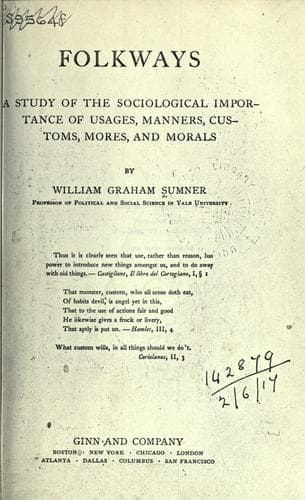
Folkways: A Study of the Sociological Importance of Usages, Manners, Customs, Mores, and MoralsSumner, William Graham
General
Folkways: A Study of the Sociological Importance of Usages, Manners, Customs, Mores, and Morals
Sumner, William Graham
Manners and customs
+295. Laws changed in favor of slaves.+ When the conquests ceased and
the supply of new slaves was reduced those slaves who were born in the
households or on the estates came into gentler relations to their
owners. Slaves rose in value and were worth more care. The old plan of
Cato became uneconomical. All sentiments were softened in the first
century as war became less constant, less important, and more remote.
The empire was an assumption by the state of functions and powers which
had been family powers and functions, and part of the _patria potestas_.
Women, children, and slaves shared in emancipation until the state made
laws to execute its jurisdiction over them. Hadrian took from masters
the power of life and death over slaves. Antoninus Pius confirmed this,
and provided that he who killed his own slave should suffer the same
penalty as he who killed the slave of another.[802] This brought the
life of every slave into the protection of the state. Under Nero a judge
was appointed to hear the complaints of slaves and to punish owners who
misused them. Domitian forbade castration. Hadrian forbade the sale of
slaves to be gladiators. The right to sell female slaves into brothels
was also abolished.[803]
+296. Christianity and slavery.+ In 1853 C. Schmidt published an essay
on the "Civil Society of the Roman World and its Transformation by
Christianity," in which he thought it right to attribute all the
softening of the mores in the first three Christian centuries to
Christianity. Lecky, on the other hand, says: "Slavery was distinctly
and formally recognized by Christianity, and no religion ever labored
more to encourage a habit of docility and passive obedience."[804]
Schmidt is obliged to take the ground that Christianity received and
accepted slavery as a current institution, in which property rights
existed, and that it suffered these to stand. If that is true, then
Christianity could not exert much influence on civil society. What
Christianity did was to counteract to a great extent the sentiment of
contempt for slaves and for work. It did this ritually, because in the
church, and especially in the Lord's Supper, all participated alike and
equally in the rites. The doctrine that Christ died for all alike
combined with the philosophical and humanitarian doctrine that men are
of the same constitution and physique to produce a state of mind hostile
to slavery. In the fourth century the church began to own great
possessions, including slaves, and it accepted the standpoint of the
property owner.[805] In the Saturnalia of Macrobius (fl. 400 A.D.)
Praetextatus reaffirms the old neostoic doctrine about slavery, of Seneca
and Dio Chrysostom. Dill[806] takes the doctrine to be the expression of
the convictions of the best and most thoughtful men of that time. It is
not to be found in Jerome, Augustine, or Chrysostom. Nevertheless the
church favored manumission and took charge of the ceremony. It
Public-domain text, read in full here on John Shaqi.
Reviews
Reviews
No reviews yet
Be the first to share your thoughts on this work.
Elsewhere in the archive
Join the Discussion
Join the discussion
Sign in to leave a comment or review.
Sign InorCreate an account