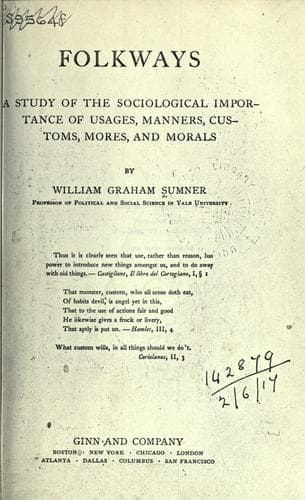
Folkways: A Study of the Sociological Importance of Usages, Manners, Customs, Mores, and MoralsSumner, William Graham
General
Folkways: A Study of the Sociological Importance of Usages, Manners, Customs, Mores, and Morals
Sumner, William Graham
Manners and customs
especially favored it when the manumitted would become priests or monks.
The church came nearest to the realization of its own doctrines when it
refused to consider slave birth a barrier to priesthood. In all the
penitential discipline of the church also bond and free were on an
equality. The intermarriage of slave and free was still forbidden.
Constantine ordered that if a free woman had intercourse with her slave
she should be executed and he should be burned alive.[807] The pagan law
only ordered that she should be reduced to slavery. The manumissions
under Constantine were believed, in the sixteenth century, to have
caused almshouses and hospitals to be built, on account of the great
numbers of helpless persons set adrift.[808] Basil the Macedonian
([Symbol: cross] 886) first enacted that slaves might have an
ecclesiastical marriage, but the prejudice of centuries made this
enactment vain.[809] The abolition of crucifixion had special value to
the slave class. There was no longer a special and most infamous mode of
execution for them. A law of Constantine forbade the separation of
members of a family of slaves.[810] These are the most important changes
in the law of slavery until the time of the codex of Justinian. Lecky
thinks that Justinian advanced the law beyond what his predecessors had
done more in regard to slavery than on any other point. His changes
touched three points: (1) He abolished all the restrictions on
enfranchisement which remained from the old pagan laws, and encouraged
it. (2) He abolished the freedmen as an intermediate class, so that
there remained only slave and free, and a senator could marry a freed
woman, i.e. a slave whom he had already freed. (3) A slave might marry a
free woman, if his master consented, and her children, born in slavery,
became free if the father was enfranchised. The punishment for the rape
of a slave woman was made death, the same as for the rape of a free
woman.[811] Isidore of Seville ([Symbol: cross] 636) said: "A just God
alloted life to men, making some slaves and some lords, that the liberty
of ill-doing on the part of slaves might be restrained by the authority
of rulers." Still he says that all men are equal before God, and that
Christ's redemption has wiped away original sin, which was the cause of
slavery.[812]
Public-domain text, read in full here on John Shaqi.
Reviews
Reviews
No reviews yet
Be the first to share your thoughts on this work.
Elsewhere in the archive
Join the Discussion
Join the discussion
Sign in to leave a comment or review.
Sign InorCreate an account