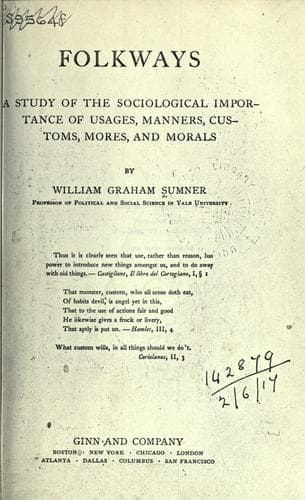
Folkways: A Study of the Sociological Importance of Usages, Manners, Customs, Mores, and MoralsSumner, William Graham
General
Folkways: A Study of the Sociological Importance of Usages, Manners, Customs, Mores, and Morals
Sumner, William Graham
Manners and customs
investigation.
+29. Harmful folkways.+ There are folkways which are positively harmful.
Very often these are just the ones for which a definite reason can be
given. The destruction of a man's goods at his death is a direct
deduction from other-worldliness; the dead man is supposed to want in
the other world just what he wanted here. The destruction of a man's
goods at his death was a great waste of capital, and it must have had a
disastrous effect on the interests of the living, and must have very
seriously hindered the development of civilization. With this custom we
must class all the expenditure of labor and capital on graves, temples,
pyramids, rites, sacrifices, and support of priests, so far as these
were supposed to benefit the dead. The faith in goblinism produced
other-worldly interests which overruled ordinary worldly interests.
Foods have often been forbidden which were plentiful, the prohibition of
which injuriously lessened the food supply. There is a tribe of Bushmen
who will eat no goat's flesh, although goats are the most numerous
domestic animals in the district.[53] Where totemism exists it is
regularly accompanied by a taboo on eating the totem animal. Whatever
may be the real principle in totemism, it overrules the interest in an
abundant food supply. "The origin of the sacred regard paid to the cow
must be sought in the primitive nomadic life of the Indo-European race,"
because it is common to Iranians and Indians of Hindostan.[54] The
Libyans ate oxen but not cows.[55] The same was true of the
Phoenicians and Egyptians.[56] In some cases the sense of a food taboo
is not to be learned. It may have been entirely capricious. Mohammed
would not eat lizards, because he thought them the offspring of a
metamorphosed clan of Israelites.[57] On the other hand, the protective
taboo which forbade killing crocodiles, pythons, cobras, and other
animals enemies of man was harmful to his interests, whatever the
motive. "It seems to be a fixed article of belief throughout southern
India, that all who have willfully or accidentally killed a snake,
especially a cobra, will certainly be punished, either in this life or
the next, in one of three ways: either by childlessness, or by leprosy,
or by ophthalmia."[58] Where this faith exists man has a greater
interest to spare a cobra than to kill it. India furnishes a great
number of cases of harmful mores. "In India every tendency of humanity
seems intensified and exaggerated. No country in the world is so
conservative in its traditions, yet no country has undergone so many
religious changes and vicissitudes."[59] "Every year thousands perish of
disease that might recover if they would take proper nourishment, and
drink the medicine that science prescribes, but which they imagine that
their religion forbids them to touch." "Men who can scarcely count
beyond twenty, and know not the letters of the alphabet, would rather
die than eat food which had been prepared by men of lower caste, unless
Public-domain text, read in full here on John Shaqi.
Reviews
Reviews
No reviews yet
Be the first to share your thoughts on this work.
Join the Discussion
Join the discussion
Sign in to leave a comment or review.
Sign InorCreate an account