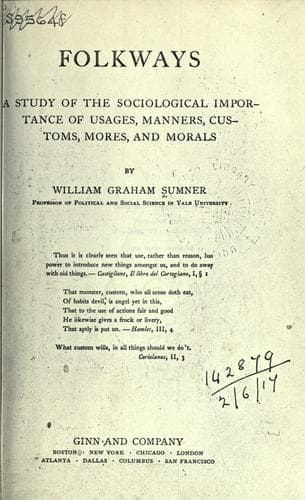
Folkways: A Study of the Sociological Importance of Usages, Manners, Customs, Mores, and MoralsSumner, William Graham
General
Folkways: A Study of the Sociological Importance of Usages, Manners, Customs, Mores, and Morals
Sumner, William Graham
Manners and customs
it had been sanctified by being offered to an idol; and would kill their
daughters rather than endure the disgrace of having unmarried girls at
home beyond twelve or thirteen years of age."[60] In the last case the
rule of obligation and duty is set by the mores. The interest comes
under vanity. The sanction of the caste rules is in a boycott by all
members of the caste. The rules are often very harmful. "The authority
of caste rests partly on written laws, partly on legendary fables or
narratives, partly on the injunctions of instructors and priests, partly
on custom and usage, and partly on the caprice and convenience of its
votaries."[61] The harm of caste rules is so great that of late they
have been broken in some cases, especially in regard to travel over sea,
which is a great advantage to Hindoos.[62] The Hindoo folkways in regard
to widows and child marriages must also be recognized as socially
harmful.
+30. How "true" and "right" are found.+ If a savage puts his hand too
near the fire, he suffers pain and draws it back. He knows nothing of
the laws of the radiation of heat, but his instinctive action conforms
to that law as if he did know it. If he wants to catch an animal for
food, he must study its habits and prepare a device adjusted to those
habits. If it fails, he must try again, until his observation is "true"
and his device is "right." All the practical and direct element in the
folkways seems to be due to common sense, natural reason, intuition, or
some other original mental endowment. It seems rational (or
rationalistic) and utilitarian. Often in the mythologies this ultimate
rational element was ascribed to the teaching of a god or a culture
hero. In modern mythology it is accounted for as "natural."
Although the ways adopted must always be really "true" and "right" in
relation to facts, for otherwise they could not answer their purpose,
such is not the primitive notion of true and right.
Public-domain text, read in full here on John Shaqi.
Reviews
Reviews
No reviews yet
Be the first to share your thoughts on this work.
Join the Discussion
Join the discussion
Sign in to leave a comment or review.
Sign InorCreate an account