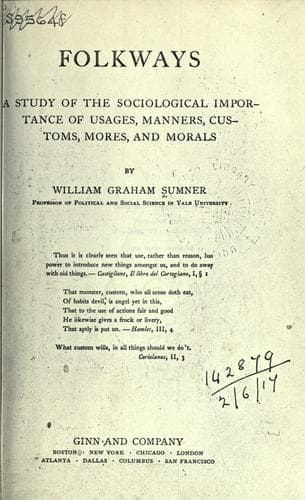
Folkways: A Study of the Sociological Importance of Usages, Manners, Customs, Mores, and MoralsSumner, William Graham
General
Folkways: A Study of the Sociological Importance of Usages, Manners, Customs, Mores, and Morals
Sumner, William Graham
Manners and customs
+32. The folkways are "true."+ The folkways are necessarily "true" with
respect to some world philosophy. Pain forced men to think. The ills of
life imposed reflection and taught forethought. Mental processes were
irksome and were not undertaken until painful experience made them
unavoidable.[63] With great unanimity all over the globe primitive men
followed the same line of thought. The dead were believed to live on as
ghosts in another world just like this one. The ghosts had just the same
needs, tastes, passions, etc., as the living men had had. These
transcendental notions were the beginning of the mental outfit of
mankind. They are articles of faith, not rational convictions. The
living had duties to the ghosts, and the ghosts had rights; they also
had power to enforce their rights. It behooved the living therefore to
learn how to deal with ghosts. Here we have a complete world philosophy
and a life policy deduced from it. When pain, loss, and ill were
experienced and the question was provoked, Who did this to us? the world
philosophy furnished the answer. When the painful experience forced the
question, Why are the ghosts angry and what must we do to appease them?
the "right" answer was the one which fitted into the philosophy of ghost
fear. All acts were therefore constrained and trained into the forms of
the world philosophy by ghost fear, ancestral authority, taboos, and
habit. The habits and customs created a practical philosophy of welfare,
and they confirmed and developed the religious theories of goblinism.
+33. Relation of world philosophy and folkways.+ It is quite impossible
for us to disentangle the elements of philosophy and custom, so as to
determine priority and the causative position of either. Our best
judgment is that the mystic philosophy is regulative, not creative, in
its relation to the folkways. They reacted upon each other. The faith in
the world philosophy drew lines outside of which the folkways must not
go. Crude and vague notions of societal welfare were formed from the
notion of pleasing the ghosts, and from such notions of expediency as
the opinion that, if there were not children enough, there would not be
warriors enough, or that, if there were too many children, the food
supply would not be adequate. The notion of welfare was an inference and
resultant from these mystic and utilitarian generalizations.
+34. Definition of the mores.+ When the elements of truth and right are
developed into doctrines of welfare, the folkways are raised to another
plane. They then become capable of producing inferences, developing into
new forms, and extending their constructive influence over men and
society. Then we call them the mores. The mores are the folkways,
including the philosophical and ethical generalizations as to societal
welfare which are suggested by them, and inherent in them, as they grow.
Public-domain text, read in full here on John Shaqi.
Reviews
Reviews
No reviews yet
Be the first to share your thoughts on this work.
Join the Discussion
Join the discussion
Sign in to leave a comment or review.
Sign InorCreate an account