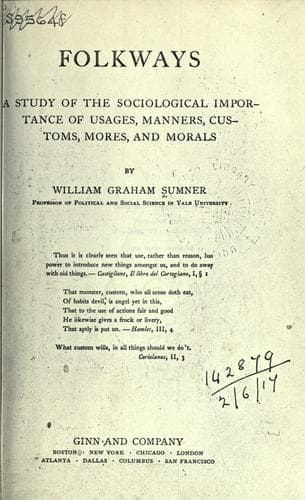
Folkways: A Study of the Sociological Importance of Usages, Manners, Customs, Mores, and Morals — John Shaqi
Folkways: A Study of the Sociological Importance of Usages, Manners, Customs, Mores, and MoralsSumner, William Graham
General
Folkways: A Study of the Sociological Importance of Usages, Manners, Customs, Mores, and Morals
Sumner, William Graham
Manners and customs
+35. Taboos.+ The mores necessarily consist, in a large part, of taboos,
which indicate the things which must not be done. In part these are
dictated by mystic dread of ghosts who might be offended by certain
acts, but they also include such acts as have been found by experience
to produce unwelcome results, especially in the food quest, in war, in
health, or in increase or decrease of population. These taboos always
contain a greater element of philosophy than the positive rules, because
the taboos contain reference to a reason, as, for instance, that the
act would displease the ghosts. The primitive taboos correspond to the
fact that the life of man is environed by perils. His food quest must be
limited by shunning poisonous plants. His appetite must be restrained
from excess. His physical strength and health must be guarded from
dangers. The taboos carry on the accumulated wisdom of generations,
which has almost always been purchased by pain, loss, disease, and
death. Other taboos contain inhibitions of what will be injurious to the
group. The laws about the sexes, about property, about war, and about
ghosts, have this character. They always include some social philosophy.
They are both mystic and utilitarian, or compounded of the two.
Taboos may be divided into two classes, (1) protective and (2)
destructive. Some of them aim to protect and secure, while others aim to
repress or exterminate. Women are subject to some taboos which are
directed against them as sources of possible harm or danger to men, and
they are subject to other taboos which put them outside of the duties or
risks of men. On account of this difference in taboos, taboos act
selectively, and thus affect the course of civilization. They contain
judgments as to societal welfare.
Public-domain text, read in full here on John Shaqi.
Reviews
Reviews
No reviews yet
Be the first to share your thoughts on this work.
Join the Discussion
Join the discussion
Sign in to leave a comment or review.
Sign InorCreate an account