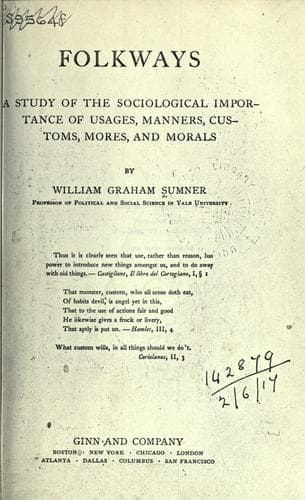
Folkways: A Study of the Sociological Importance of Usages, Manners, Customs, Mores, and MoralsSumner, William Graham
General
Folkways: A Study of the Sociological Importance of Usages, Manners, Customs, Mores, and Morals
Sumner, William Graham
Manners and customs
XIII. KINSHIP, BLOOD REVENGE, PRIMITIVE JUSTICE, PEACE
UNIONS 493
XIV. UNCLEANNESS AND THE EVIL EYE 509
XV. THE MORES CAN MAKE ANYTHING RIGHT AND PREVENT
CONDEMNATION OF ANYTHING 521
XVI. SACRAL HARLOTRY, CHILD SACRIFICE 533
XVII. POPULAR SPORTS, EXHIBITIONS, DRAMA 560
XVIII. ASCETICISM 605
XIX. EDUCATION, HISTORY 628
XX. LIFE POLICY, VIRTUE VS. SUCCESS 639
LIST OF BOOKS 655
(Titles are under the name of the author, or the leading word
of the title)
INDEX 671
FOLKWAYS
CHAPTER I
FUNDAMENTAL NOTIONS OF THE FOLKWAYS
AND OF THE MORES
Definition and mode of origin of the folkways.--The folkways are
a societal force.--Folkways are made unconsciously.--Impulse
and instinct; primeval stupidity; magic.--The strain of
improvement and consistency.--The aleatory element.--All
origins are lost in mystery.--Spencer on primitive custom.--
Good and bad luck; ills of life; goodness and happiness.--
Illustrations.--Immortality and compensation.--Tradition and
its restraints.--The concepts of "primitive society";
"we-groups" and "others-groups."--Sentiments in the in-group
towards out-groups.--Ethnocentrism.--Illustrations.--
Patriotism.--Chauvinism.--The struggle for existence and the
competition of life; antagonistic cooperation.--Four motives:
hunger, love, vanity, fear.--The process of making folkways.--
Suggestion and suggestibility.--Suggestion in education.--
Manias.--Suggestion in politics.--Suggestion and criticism.--
Folkways based on false inferences.--Harmful folkways.--How
"true" and "right" are found.--The folkways are right; rights;
morals.--The folkways are true.--Relations of world philosophy
to folkways.--Definition of the mores.--Taboos.--No primitive
philosophizing; myths; fables; notion of social welfare.--The
imaginative element.--The ethical policy and the success
policy.--Recapitulation.--Scope and method of the mores.--
Integration of the mores of a group or age.--Purpose of the
present work.--Why use the word "mores."--The mores are a
directive force.--Consistency in the mores.--The mores of
subgroups.--What are classes?--Classes rated by societal
value.--Class; race; group solidarity.--The masses and the
mores.--Fallacies about the classes and the masses.--Action of
the masses on ideas.--Organization of the masses.--Institutions
of civil liberty.--The common man.--The "people"; popular
impulses.--Agitation.--The ruling element in the masses.--The
Public-domain text, read in full here on John Shaqi.
Reviews
Reviews
No reviews yet
Be the first to share your thoughts on this work.
Join the Discussion
Join the discussion
Sign in to leave a comment or review.
Sign InorCreate an account