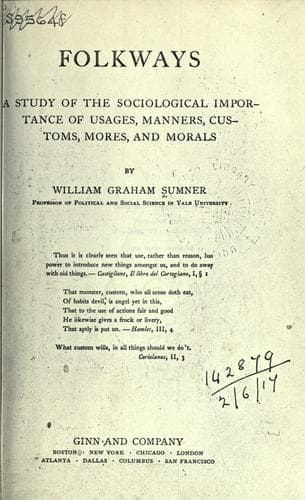
Folkways: A Study of the Sociological Importance of Usages, Manners, Customs, Mores, and MoralsSumner, William Graham
General
Folkways: A Study of the Sociological Importance of Usages, Manners, Customs, Mores, and Morals
Sumner, William Graham
Manners and customs
mores and institutions.--Laws.--How laws and institutions
differ from mores.--Difference between mores and some cognate
things.--Goodness or badness of the mores.--More exact
definition of the mores.--Ritual.--The ritual of the mores.--
Group interests and policy.--Group interests and folkways.--
Force in the folkways.--Might and right.--Status.--
Conventionalization.--Conventions indispensable.--The "ethos"
or group character; Japan.--Chinese ethos.--Hindoo ethos.--
European ethos.
+1. Definition and mode of origin of the folkways.+ If we put together
all that we have learned from anthropology and ethnography about
primitive men and primitive society, we perceive that the first task of
life is to live. Men begin with acts, not with thoughts. Every moment
brings necessities which must be satisfied at once. Need was the first
experience, and it was followed at once by a blundering effort to
satisfy it. It is generally taken for granted that men inherited some
guiding instincts from their beast ancestry, and it may be true,
although it has never been proved. If there were such inheritances, they
controlled and aided the first efforts to satisfy needs. Analogy makes
it easy to assume that the ways of beasts had produced channels of habit
and predisposition along which dexterities and other psychophysical
activities would run easily. Experiments with newborn animals show that
in the absence of any experience of the relation of means to ends,
efforts to satisfy needs are clumsy and blundering. The method is that
of trial and failure, which produces repeated pain, loss, and
disappointments. Nevertheless, it is a method of rude experiment and
selection. The earliest efforts of men were of this kind. Need was the
impelling force. Pleasure and pain, on the one side and the other, were
the rude constraints which defined the line on which efforts must
proceed. The ability to distinguish between pleasure and pain is the
only psychical power which is to be assumed. Thus ways of doing things
were selected, which were expedient. They answered the purpose better
than other ways, or with less toil and pain. Along the course on which
efforts were compelled to go, habit, routine, and skill were developed.
The struggle to maintain existence was carried on, not individually, but
in groups. Each profited by the other's experience; hence there was
concurrence towards that which proved to be most expedient. All at last
adopted the same way for the same purpose; hence the ways turned into
customs and became mass phenomena. Instincts were developed in
connection with them. In this way folkways arise. The young learn them
by tradition, imitation, and authority. The folkways, at a time, provide
for all the needs of life then and there. They are uniform, universal in
the group, imperative, and invariable. As time goes on, the folkways
become more and more arbitrary, positive, and imperative. If asked why
Public-domain text, read in full here on John Shaqi.
Reviews
Reviews
No reviews yet
Be the first to share your thoughts on this work.
Join the Discussion
Join the discussion
Sign in to leave a comment or review.
Sign InorCreate an account