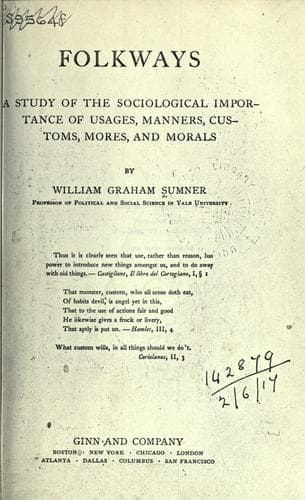
Folkways: A Study of the Sociological Importance of Usages, Manners, Customs, Mores, and MoralsSumner, William Graham
General
Folkways: A Study of the Sociological Importance of Usages, Manners, Customs, Mores, and Morals
Sumner, William Graham
Manners and customs
will,--isolated, and most effectively ostracized." "The events of the
[modern] reconstruction strangely illustrate the action of such
instinct [of adaptation] in the face of peril,--the readjustment of
internal relations to sudden changes of environment. The nation had
found its old political system powerless before the new conditions, and
it transformed that system. It had found its military organization
incapable of defending it, and it reconstructed that organization. It
had found its educational system useless in the presence of unforeseen
necessities, and it had replaced that system, simultaneously crippling
the power of Buddhism, which might otherwise have offered serious
opposition to the new developments required."[87] To this it must be
added that people who have had commercial and financial dealings with
Japanese report that they are untruthful and tricky in transactions of
that kind. If they cannot "reform" these traits there will be important
consequences of them in the developments of the near future.
+77. Chinese ethos.+ It is evident that we have in the Japanese a case
of an ethos, from the habits of artisans to the manners of nobles and
the military system, which is complete, consistent, authoritative, and
very different from our own. A similar picture of the Chinese might be
drawn, from which it would appear that they also have a complete and
firm ethos, which resembles in general the Japanese, but has its
individual traits and characteristic differences.[88] The ethos of the
Japanese, from the most ancient times, has been fundamentally militant.
That of the Chinese is industrial and materialistic.
+78. Hindoo ethos.+ The Hindoos, again, have a strongly marked ethos.
They have a name for it--_kharma_, which Nivedita says might be
translated "national righteousness." It "applies to that whole system of
complex action and interaction on planes moral, intellectual, economic,
industrial, political, and domestic, which we know as India, or the
national habit.... By their attitude to it, Pathan, Mogul, and
Englishman are judged, each in his turn, by the Indian peasantry."[89]
The ethos of one group always furnishes the standpoint from which it
criticises the ways of any other group.
Public-domain text, read in full here on John Shaqi.
Reviews
Reviews
No reviews yet
Be the first to share your thoughts on this work.
Elsewhere in the archive
Join the Discussion
Join the discussion
Sign in to leave a comment or review.
Sign InorCreate an account