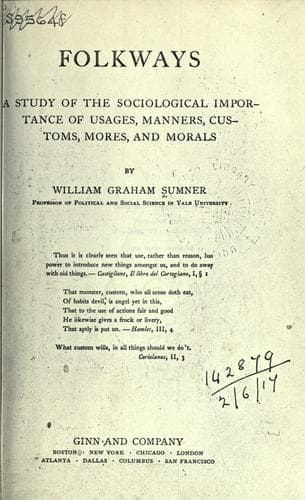
Folkways: A Study of the Sociological Importance of Usages, Manners, Customs, Mores, and MoralsSumner, William Graham
General
Folkways: A Study of the Sociological Importance of Usages, Manners, Customs, Mores, and Morals
Sumner, William Graham
Manners and customs
+3. Folkways are made unconsciously.+ It is of the first importance to
notice that, from the first acts by which men try to satisfy needs, each
act stands by itself, and looks no further than the immediate
satisfaction. From recurrent needs arise habits for the individual and
customs for the group, but these results are consequences which were
never conscious, and never foreseen or intended. They are not noticed
until they have long existed, and it is still longer before they are
appreciated. Another long time must pass, and a higher stage of mental
development must be reached, before they can be used as a basis from
which to deduce rules for meeting, in the future, problems whose
pressure can be foreseen. The folkways, therefore, are not creations of
human purpose and wit. They are like products of natural forces which
men unconsciously set in operation, or they are like the instinctive
ways of animals, which are developed out of experience, which reach a
final form of maximum adaptation to an interest, which are handed down
by tradition and admit of no exception or variation, yet change to meet
new conditions, still within the same limited methods, and without
rational reflection or purpose. From this it results that all the life
of human beings, in all ages and stages of culture, is primarily
controlled by a vast mass of folkways handed down from the earliest
existence of the race, having the nature of the ways of other animals,
only the topmost layers of which are subject to change and control, and
have been somewhat modified by human philosophy, ethics, and religion,
or by other acts of intelligent reflection. We are told of savages that
"It is difficult to exhaust the customs and small ceremonial usages of a
savage people. Custom regulates the whole of a man's actions,--his
bathing, washing, cutting his hair, eating, drinking, and fasting. From
his cradle to his grave he is the slave of ancient usage. In his life
there is nothing free, nothing original, nothing spontaneous, no
progress towards a higher and better life, and no attempt to improve his
condition, mentally, morally, or spiritually."[1] All men act in this
way with only a little wider margin of voluntary variation.
Public-domain text, read in full here on John Shaqi.
Reviews
Reviews
No reviews yet
Be the first to share your thoughts on this work.
Join the Discussion
Join the discussion
Sign in to leave a comment or review.
Sign InorCreate an account