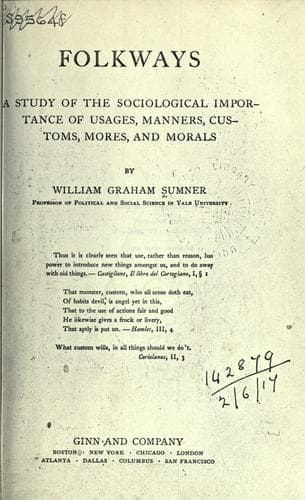
Folkways: A Study of the Sociological Importance of Usages, Manners, Customs, Mores, and MoralsSumner, William Graham
General
Folkways: A Study of the Sociological Importance of Usages, Manners, Customs, Mores, and Morals
Sumner, William Graham
Manners and customs
+4. Impulse and instinct. Primeval stupidity. Magic.+ "The mores
(_Sitten_) rest on feelings of pleasure or pain, which either directly
produce actions or call out desires which become causes of action."[2]
"Impulse is not an attribute of living creatures, like instinct. The
only phenomenon to which impulse applies is that men and other animals
imitate what they see others, especially of their own species, do, and
that they accomplish this imitation the more easily, the more their
forefathers practiced the same act. The thing imitated, therefore, must
already exist, and cannot be explained as an impulse." "As soon as
instinct ceased to be sole ruler of living creatures, including inchoate
man, the latter must have made mistakes in the struggle for existence
which would soon have finished his career, but that he had instinct and
the imitation of what existed to guide him. This human primeval
stupidity is the ultimate ground of religion and art, for both come
without any interval, out of the magic which is the immediate
consequence of the struggle for existence when it goes beyond instinct."
"If we want to determine the origin of dress, if we want to define
social relations and achievements, e.g. the origin of marriage, war,
agriculture, cattle breeding, etc., if we want to make studies in the
psyche of nature peoples,--we must always pass through magic and belief
in magic. One who is weak in magic, e.g. a ritually unclean man, has a
'bad body,' and reaches no success. Primitive men, on the other hand,
win their success by means of their magical power and their magical
preparations, and hence become 'the noble and good.' For them there is
no other morality [than this success]. Even the technical dexterities
have certainly not been free from the influence of belief in magic."[3]
Public-domain text, read in full here on John Shaqi.
Reviews
Reviews
No reviews yet
Be the first to share your thoughts on this work.
Join the Discussion
Join the discussion
Sign in to leave a comment or review.
Sign InorCreate an account