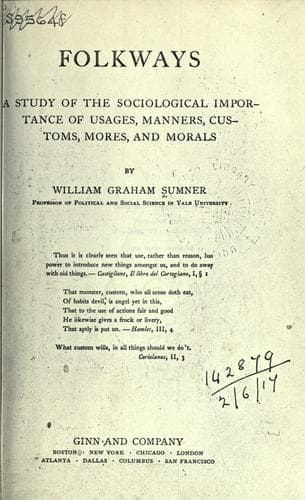
Folkways: A Study of the Sociological Importance of Usages, Manners, Customs, Mores, and MoralsSumner, William Graham
General
Folkways: A Study of the Sociological Importance of Usages, Manners, Customs, Mores, and Morals
Sumner, William Graham
Manners and customs
+96. Case of the Hindoos.+ Nivedita[113] thinks that the Hindoos have
adopted foreign culture easily. "One of the most striking features of
Hindoo society during the past fifty years has been the readiness of the
people to adopt a foreign form of culture, and to compete with those
who are native to that culture on equal terms." Monier-Williams tells
us, however, that each Hindoo "finds himself cribbed and confined in all
his movements, bound and fettered in all he does by minute traditional
regulations. He sleeps and wakes, dresses and undresses, sits down and
stands up, goes out and comes in, eats and drinks, speaks and is silent,
acts and refrains from acting, according to ancient rule."[114] As yet,
therefore, this people assumes competition with the English without
giving up its ancient burdensome social ritual. It accepts the handicap.
+97. Reforms of Joseph II.+ The most remarkable case of reform attempted
by authority, and arbitrary in its method, is that of the reforms
attempted by Joseph II, emperor of Germany. His kingdoms were suffering
from the persistence of old institutions and mores. They needed
modernizing. This he knew and, as an absolute monarch, he ordained
changes, nearly all of which were either the abolition of abuses or the
introduction of real improvements. He put an end to survivals of
mediaeval clericalism, established freedom of worship, made marriage a
civil contract, abolished class privilege, made taxation uniform, and
replaced serfdom in Bohemia by the form of villanage which existed in
Austria. In Hungary he ordered the use of the German language instead of
Latin, as the civil language. Interferences with language act as counter
suggestion. Common sense and expediency were in favor of the use of the
German language, but the order to use it provoked a great outburst of
national enthusiasm which sought demonstration in dress, ceremonies, and
old usages. Many of the other changes made by the emperor antagonized
vested interests of nobles and ecclesiastics, and he was forced to
revoke them. He promulgated orders which affected the mores, and the
mental or moral discipline of his subjects. If a man came to enroll
himself as a deist a second time, he was to receive twenty-four blows
with the rod, not because he was a deist, but because he called himself
something about which he could not know what it is. No coffins were to
be used, corpses were to be put in sacks and buried in quicklime.
Probably this law was wise from a purely rational point of view, but it
touched upon a matter in regard to which popular sentiment is very
tender even when the usage is most irrational. "Many a usage and
superstition was so closely interwoven with the life of the people that
it could not be torn away by regulation, but only by education."
Non-Catholics were given full civil rights. None were to be excluded
from the cemeteries. The unilluminated Jews would have preferred that
there should be no change in the laws.
Public-domain text, read in full here on John Shaqi.
Reviews
Reviews
No reviews yet
Be the first to share your thoughts on this work.
Elsewhere in the archive
Join the Discussion
Join the discussion
Sign in to leave a comment or review.
Sign InorCreate an account