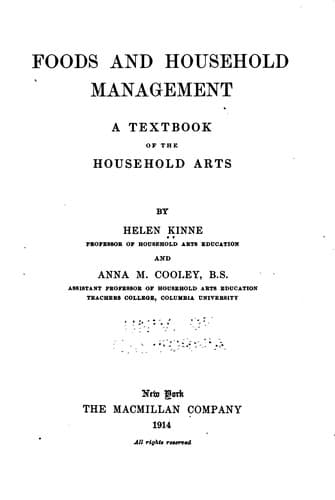
Foods and Household Management: A Textbook of the Household ArtsKinne, Helen
General
Foods and Household Management: A Textbook of the Household Arts
Kinne, Helen
Cooking; Food; Home economics
Food for an invalid must always be given in its most digestible forms.
Milk is one of the most valuable foods in sickness, not only because it
supplies so many body needs, but because it can be used in so many
ways,——hot, or cold, flavored or plain, made into junkets or sherbets,
combined with eggs in eggnogs and custards, fermented as in kumyss or
soured as in buttermilk or zoolak. In some form or other milk can almost
always be made digestible. Eggs are also of great value, not only poached
or dropped and served on toast, but as dainty omelets, or in beverages, as
eggnog, egg lemonade, and orangeade. Mild fruit juices, as orange, grape,
or pineapple, are not only refreshing but of considerable fuel value. If
there is no fever, chicken, lamb chops, tender broiled steak or roast beef
may serve to add variety to the menu. Broths stimulate the appetite and
help digestion, though they are of little or no food value themselves.
Cereals, eggs, and milk may be added to increase their food value. Cereals
in the form of gruels or delicate puddings, as cornstarch blancmange and
tapioca cream, are easily digested. Vegetables are best given rather
sparingly, and only delicate, mild-flavored ones, such as spinach or
asparagus, if digestion is much disturbed. In getting an invalid to take
sufficient food, much depends upon the attractiveness of the service.
Remember that very little things, like a fingermark on a glass, or coffee
spilled into the saucer, may take away appetite and prevent enough food
being eaten. Food in small quantities and taken at more frequent intervals
than in health helps towards the best results. Knowledge of what
particular diet is best in different diseases comes only through careful
study of the science of nutrition after much study of chemistry and
physiology.
EXERCISES
1. Calculate your own energy requirement.
2. Calculate the energy requirement of your family group.
3. Find the cost for your locality of the dietary arranged from Menu No.
1.
4. Make a dietary yielding 10,000 Calories, from ten to fifteen per cent
of which shall be protein calories, from Menu No. II, and calculate its
cost.
5. Find out the lowest sum for which a balanced dietary could be obtained
in your locality.
6. Revise the dietary from Menu No. I, so that it shall not cost over one
cent per hundred Calories.
7. Plan an ideal day’s dietary for yourself.
8. Plan a day’s dietary for an invalid which shall yield 2000 Calories,
300 of which shall be protein Calories.
CHAPTER XIX
THE HOUSEHOLD BUDGET
Public-domain text, read in full here on John Shaqi.
Reviews
Reviews
No reviews yet
Be the first to share your thoughts on this work.
Elsewhere in the archive
Join the Discussion
Join the discussion
Sign in to leave a comment or review.
Sign InorCreate an account