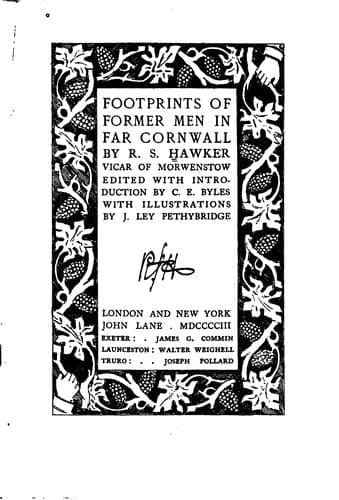
Footprints of Former Men in Far CornwallHawker, Robert Stephen
History
Footprints of Former Men in Far Cornwall
Hawker, Robert Stephen
Cornwall (England : County) -- History
Transcriber's Note
Superscript text is indicated by caret signs, e.g. "Esq^{re}".
FOOTPRINTS OF FORMER
MEN IN FAR CORNWALL
[Illustration: Yours thankfully
RS Hawker]
FOOTPRINTS OF
FORMER MEN IN
FAR CORNWALL
BY R. S. HAWKER
VICAR OF MORWENSTOW
EDITED WITH INTRODUCTION
BY C. E. BYLES
WITH ILLUSTRATIONS
BY J. LEY PETHYBRIDGE
[Illustration]
LONDON AND NEW YORK
JOHN LANE . MDCCCCIII
EXETER: JAMES G. COMMIN
LAUNCESTON: WALTER WEIGHELL
TRURO: JOSEPH POLLARD
WILLIAM CLOWES AND SONS, LIMITED, LONDON AND BECCLES.
PREFACE
Hawker’s prose sketches appeared originally as contributions to various
periodicals, and in 1870 they were published for him in book form by
Mr. John Russell Smith, as “Footprints of Former Men in Far Cornwall.”
In 1893, eighteen years after his death, a new edition was issued by
Messrs. Blackwood, entitled “The Prose Works of Rev. R. S. Hawker,”
containing two essays previously unpublished, “Humphrey Vivian” and
“Old Trevarten.” The late Mr. J. G. Godwin, who was Hawker’s friend
and adviser in literary matters, edited the volume, and added the
bibliographical footnotes to the several papers. In the present
edition it has been thought appropriate to revert to Hawker’s own more
picturesque title, and this is to be done also in the case of his
poetical works, which will shortly be re-issued as “Cornish Ballads
and other Poems.” The two books will thus form companion volumes. It
is interesting to read them concurrently, and to compare his treatment
of the same themes in prose and verse. An attempt has been made in
the notes to assist such a comparison by indicating some of the more
obvious parallels. In the prose, as in the poems, there is the same
deep and peculiar love of symbol and miracle and superstition, but
the prose further reveals, what might not be suspected from the poems
alone, that Hawker was a humourist as much as a mystic.
Hawker won his literary reputation as a ballad-writer, but his prose
also deserves a share in his fame. He has the gift of style. Like his
handwriting, which makes a manuscript of his a thing of beauty in
itself, it is bold and clear, free from prettiness or affectation, but
with the massive grace of his native rocks, and made distinctive by
a characteristic touch of archaism. The rugged scenery of his abode
had its influence upon his work. He was a hewer of words, as Daniel
Gumb was a hewer of stone, and his language has the strength of rough
masonry wrought in a broad and homely manner out of solid granite. The
sea, and the great spaces of lonely moorland that surrounded him, gave
to his work a sense of breadth and freedom. He is always at his best in
describing his own dearly loved Cornwall, and in particular the wild
coast by which all his years were spent. Perhaps the finest passage of
this kind is that which concludes the legend of Daniel Gumb, and which
forms a prose counterpart to that grand ending of “The Quest of the
Sangraal:”
Public-domain text, read in full here on John Shaqi.
Reviews
Reviews
No reviews yet
Be the first to share your thoughts on this work.
Join the Discussion
Join the discussion
Sign in to leave a comment or review.
Sign InorCreate an account