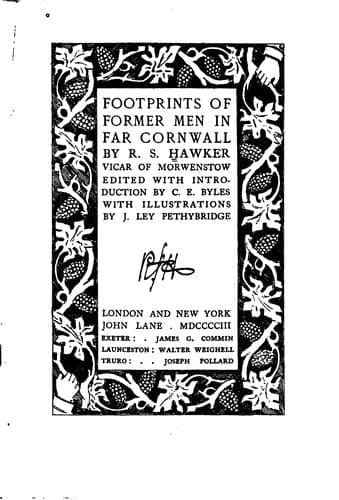
Footprints of Former Men in Far CornwallHawker, Robert Stephen
History
Footprints of Former Men in Far Cornwall
Hawker, Robert Stephen
Cornwall (England : County) -- History
A strange and striking acoustic result is accomplished by this and by
similar chancel-screens: they act as the tympanum of the structure, and
increase and reverberate the volume of sound. The voice uttered at the
altar-side smites the hollow work of the screen, and is carried onward,
as by some echoing instrument, into the nave and aisles; so that the
lattice-work of the chancel, which at first thought might appear to
impede the transit of the voice, does in reality grasp and deliver into
stronger echo the ministry of tone.
Just outside the screen, and at the step of the nave, is the grave
of a priest. It is identified by the reversed position of the carved
cross on the stone, which also indicates the self-same attitude in
the corpse. The head is laid down toward the east, while in all
secular interment the head is turned to the west. Until the era of
the Reformation, or possibly to a later date, the head of the priest
upon the bier for burial, and afterwards in the grave, was always
placed “versus altare;” and, according to all ecclesiastical usage,
the discipline was doctrinal also. The following is the reason as laid
down by Durandus and other writers. Because the east, “the gate of the
morning,” is the keblah of Christian hope, inasmuch as the Messiah,
whose symbolic name was “The Orient,” thence arrived, and thence, also,
will return on the chariots of cloud for the Judgment: we therefore
place our departed ones with their heads westward, and their feet and
faces towards the eastern sky,[20] that at the outshine of the Last
Day, and the sound of the archangel, they may start from their dust,
like soldiers from their sleep, and stand up before the Son of man
suddenly! But the apostles were to sit on future thrones and to assist
at the Judgment: the Master was to arrive for doom amid His ancients
gloriously, and the saints were to judge the world. These prophecies
were symbolised by the burial of the clergy, and thence, in contrast
with other dead, their posture in the grave. It was to signify that it
would be their office to arise and to “follow the Lord in the air,”
when He shall arrive from the east and pass onward, gathering up
His witnesses toward the west. Thus, in the posture of the departed
multitudes, the sign is, “We look for the Son of Man: ad Orientem
Judah.” And in the attitude of His appointed ministers, thus saith the
legend on the tombs of His priests, “They arose and followed Him.”
Public-domain text, read in full here on John Shaqi.
Reviews
Reviews
No reviews yet
Be the first to share your thoughts on this work.
Join the Discussion
Join the discussion
Sign in to leave a comment or review.
Sign InorCreate an account