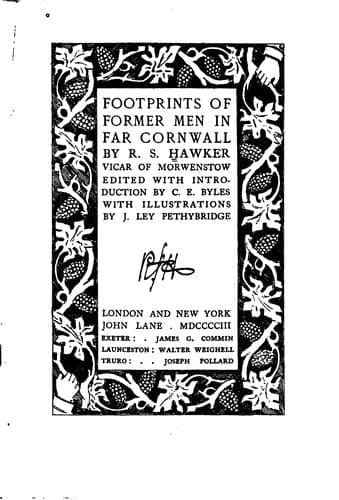
Footprints of Former Men in Far CornwallHawker, Robert Stephen
History
Footprints of Former Men in Far Cornwall
Hawker, Robert Stephen
Cornwall (England : County) -- History
The eastern window of the chancel,[21] as its legend records, is the
pious and dutiful oblation of Rudolph, Baron Clinton, and Georgiana
Elizabeth his wife. The central figure embodies the legend of St.
Morwenna, who stands in the attitude of the teacher of the Princess
Edith, daughter of Ethelwolf the Founder King; on the one side is shown
St. Peter, and on the other St. Paul. The upper spandrels are filled
with a Syrian lamb, a pelican with her brood, and the three first
letters of the Saviour’s name. The window[22] itself is the recent
offering of two noble minds; and while on this theme we may be pardoned
for the natural boast that the patrons of this chancel have called by
the name of Morwenna one of the fair and graceful daughters of their
house. “Nomen, omen,” was the Roman saying,--“Nomen, numen,” be our
proverb now! But before we proceed to descend the three steps of the
chancel floor, so obviously typical of Faith, Hope, and Charity, let us
look westward through the tower-arch; and as we look we discover that
the builders, either by chance or design, have turned aside or set out
of proportional place the western window of the tower. Is this really
so, or does the wall of the chancel swerve? The deviation was intended,
nor without an error could we render the crooked straight. And the
reason is said to be this: when our Redeemer died, at the utterance
of the word τετέλεσται, “It is done!” His head declined towards His
right shoulder, and in that attitude He chose to die. Now it was to
commemorate this drooping of the Saviour’s head, to record in stone
this eloquent gesture of our Lord, that the “wise in heart,” who traced
this church in the actual outline of a cross, departed from the precise
rules of architect and carpenter.
The southern aisle, dedicated to St. John the Baptist, with its
granite and dunstone pillars, is of the later Decorated order, and
is remarkable for its singular variety of material in stone. Granite
pillars are surmounted by arches of dunstone; and, _vice versa_,
dunstone arches by pillared granite. This is again a striking example
of doctrine proclaimed in structure, and is symbolic of the fact
that the Spiritual Church gathered into one body every hue and kind
of belief; whereas “Jew and Greek, Barbarian and Scythian, bond and
free,” were to be all one in Christ Jesus: so the material building
personified, in its various and visible embrace, one Church to grasp,
and a single roof to bend over all. This, the last addition to the
ancient sanctuary of St. Morwenna, bears on the capital of a pillar
the date A.D. 1475,[23] and thus the total structure stands a graphic
monument of the growth and stature of a scene of ancient worship, which
had been embodied and completed before the invention of printing and
other modern arts had worked their revolution upon Western Europe.
Public-domain text, read in full here on John Shaqi.
Reviews
Reviews
No reviews yet
Be the first to share your thoughts on this work.
Join the Discussion
Join the discussion
Sign in to leave a comment or review.
Sign InorCreate an account