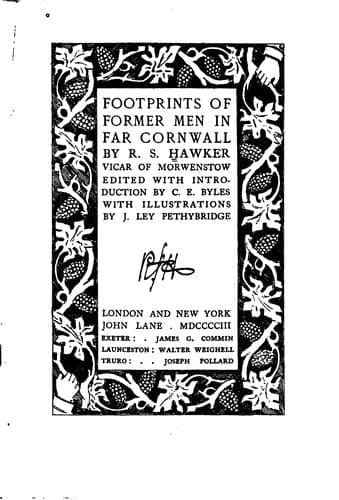
Footprints of Former Men in Far CornwallHawker, Robert Stephen
History
Footprints of Former Men in Far Cornwall
Hawker, Robert Stephen
Cornwall (England : County) -- History
The worshipper must descend three steps of stone as he enters into this
aisle of St. John; and this gradation is intended to recall the time
and the place where the multitude went down into the river of Dan “at
Bethabara, beyond Jordan, where John was baptising.”
The churchyard of Morwenstow is the scene of other features of a remote
antiquity. The roof of the total church--chancel, nave, northern and
southern aisles--is of wood. Shingles of rended oak occupy the place of
the usual, but far more recent, tiles which cover other churches; and
it is not a little illustrative of the antique usages of this remote
and lonely sanctuary, that no change has been wrought, in the long
lapse of ages, in this unique and costly, but fit and durable, roofing.
It supplies a singular illustration of the Syriac version of the 90th
Psalm, wherein, with prophetic reference to these commemorations of the
death-bed of the Messias, it is written, “Lord, Thou hast been our
roof from generation to generation.”
The northern side of the churchyard is, according to ancient usage,
devoid of graves.[24] This is the common result of an unconscious sense
among the people of the doctrine of regions--a thought coeval with
the inspiration of the Christian era. This is their division.[25] The
east was held to be the realm of the oracles, the especial gate of the
throne of God; the west was the domain of the people--the Galilee of
all nations was there; the south, the land of the mid-day, was sacred
to things heavenly and divine; but the north was the devoted region
of Satan and his hosts, the lair of the demon and his haunt. In some
of our ancient churches, and in the church of Welcombe,[26] a hamlet
bordering on Morwenstow, over against the font, and in the northern
wall, there is an entrance named the Devil’s door: it was thrown open
at every baptism, at the Renunciation, for the escape of the fiend;
while at every other time it was carefully closed. Hence, and because
of the doctrinal suggestion of the ill-omened scenery of the northern
grave-ground, came the old dislike[27] to sepulture on the north side,
so strikingly visible around this church.
The events of the last twenty years have added fresh interest to
God’s acre, for such is the exact measure of the grave ground of St.
Morwenna. Along and beneath the southern trees, side by side, are
the graves of between thirty and forty seamen, hurled by the sea, in
shipwreck, on the neighbouring rocks, and gathered up and buried there
by the present vicar and his people. The crews of three lost vessels,
cast away upon the rocks of the glebe and elsewhere, are laid at rest
in this safe and silent ground. A legend for one recording-stone
thus commemorates a singular scene. The figurehead[28] of the brig
_Caledonia_, of Arbroath, in Scotland, stands at the graves of her
crew, in the churchyard of Morwenstow:--
Public-domain text, read in full here on John Shaqi.
Reviews
Reviews
No reviews yet
Be the first to share your thoughts on this work.
Join the Discussion
Join the discussion
Sign in to leave a comment or review.
Sign InorCreate an account