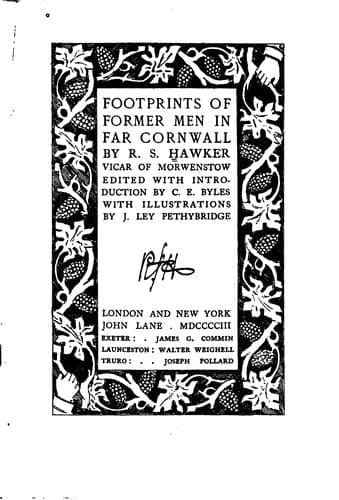
Footprints of Former Men in Far CornwallHawker, Robert Stephen
History
Footprints of Former Men in Far Cornwall
Hawker, Robert Stephen
Cornwall (England : County) -- History
There cannot be a scene more graphic in itself, or more illustrative
in its history of the gradual growth and striking development of the
Church in Celtic and Western England, than the parish of St. Morwenna.
It occupies the upper and northern nook of the county of Cornwall; shut
in and bounded on the one hand by the Severn Sea, and on the other by
the offspring of its own bosom, the Tamar River, which gushes, with its
sister stream the Torridge, from a rushy knoll on the eastern wilds
of Morwenstow.[2] Once, and in the first period of our history, it
was one wide wild stretch of rocky moorland, broken with masses of
dunstone and the sullen curve of the warrior’s barrow, and flashing
here and there with a bright rill of water or a solitary well. Neither
landmarks nor fences nor walls bounded or severed the bold, free,
untravelled Cornish domain. Wheel-tracks in old Cornwall there were
none; but strange and narrow paths gleamed across the moorlands, which
the forefathers said in their simplicity, were first traced by angel’s
feet.[3] These, in truth, were trodden and worn by religious men--by
the pilgrim as he paced his way toward his chosen and votive bourn, or
by the palmer, whose listless footsteps had neither a fixed keblah nor
a future abode. Dimly visible by the darker hue of the crushed grass,
these straight and narrow roads led the traveller along from chapelry
to cell, or to some distant and solitary cave. On the one hand, in
this scenery of the past, they would guide us to the “Chapel-piece of
St. Morwenna,” a grassy glade along the gorse-clad cliff, where to
this very day neither will bramble cling nor heather grow; and, on the
other, to the walls and roof and the grooved stone for the waterflow,
which still survive, halfway down a headlong precipice, as the relics
of St. Morwenna’s Well.[4] But what was the wanderer’s guidance along
the bleak, unpeopled surface of these Cornish moors? The wayside
cross. Such were the crosses of St. James and St. John, which even
yet give name to their ancient sites in Morwenstow, and proclaim to
the traveller that, or ever a church was reared or an altar hallowed
here, the trophy of old Syria stood in solemn stone, a beacon to the
wayfaring man, and that the soldiers of God’s army had won their
honours among the unbaptised and barbarous people!
Here, then, let us stand and survey the earliest scenery of pagan
Morwenstow. Before us lies a breadth of wild and rocky land; it is
bounded by the billowy Atlantic, with its arm of waters, and by the
slow lapse of that gliding stream of which the Keltic proverb said,
before King Arthur’s day,--
“Let Uter Pendragon do what he can,
The Tamar water will run as it ran.”
Public-domain text, read in full here on John Shaqi.
Reviews
Reviews
No reviews yet
Be the first to share your thoughts on this work.
Join the Discussion
Join the discussion
Sign in to leave a comment or review.
Sign InorCreate an account