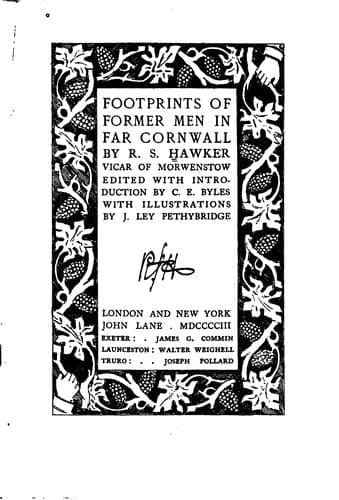
Footprints of Former Men in Far CornwallHawker, Robert Stephen
History
Footprints of Former Men in Far Cornwall
Hawker, Robert Stephen
Cornwall (England : County) -- History
Barrows curve above the dead; a stony cross stands by a mossed and
lichened well; here and there glides a shorn and vested monk, whose
function it was, often at peril of life and limb, to sprinkle the brow
of some hard-won votary, and to breathe the Gospel of the Trinity on
the startled ear of the Keltic barbarian. Let us close this theme of
thought with a few faint echoes from the River of the West:--
“Fount of a rushing river! wild flowers wreathe
The home where thy first waters sunlight claim:
The lark sits hushed beside thee while I breathe,
Sweet Tamar spring, the music of thy name!
On! through thy goodly channel, to the sea:
Pass amid heathery vale, tall rock, fair bough,
But never more with footsteps pure and free,
Or face so meek with happiness as now!
Fair is the future scenery of thy days,
Thy course domestic, and thy paths of pride;
Depths that give back the soft-eyed violet’s gaze;
Shores where tall navies march to meet the tide!
Thine, leafy Tetcott, and those neighbouring walls,
Noble Northumberland’s embowered domain:
Thine, Cartha Martha, Morwell’s rocky falls,
Storied Cotehele, and ocean’s loveliest plain.
Yet false the vision, and untrue the dream,
That lures thee from thy native wilds to stray:
A thousand griefs will mingle with that stream:
Unnumbered hearts shall sigh those waves away.
Scenes fierce with men thy seaward current laves,
Harsh multitudes will throng thy gentle brink;
Back! with the grieving concourse of thy waves;
Home! to the waters of thy childhood shrink!
Thou heedest not! thy dream is of the shore;
Thy heart is quick with life,--on! to the sea!
How will the voice of thy far streams implore
Again amid these peaceful weeds to be!
My soul! my soul! a happier choice be thine;
Thine the hushed valley and the lonely sod:
False dream, far vision, hollow hope resign,
Fast by our Tamar spring--alone with God!”
Then arrived, to people this bleak and lonely boundary with the
thoughts and doctrines of the Cross, the piety and the legend of St.
Morwenna. This was the origin of her name and place.
There dwelt in Wales in the ninth century a Keltic king, Breachan[5] by
name--it was from him that the words “Brecon” and “Brecknock” received
origin; and Gladwys was his wife and queen. They had, according to the
record of Leland, the scribe, children twenty-and-four. Now either
these were their own daughters and sons, or they were, according to the
usage of those days, the offspring of the nobles of their land, placed
for loyal and learned nurture in the palace of the king, and so called
the children of his house.
Public-domain text, read in full here on John Shaqi.
Reviews
Reviews
No reviews yet
Be the first to share your thoughts on this work.
Join the Discussion
Join the discussion
Sign in to leave a comment or review.
Sign InorCreate an account