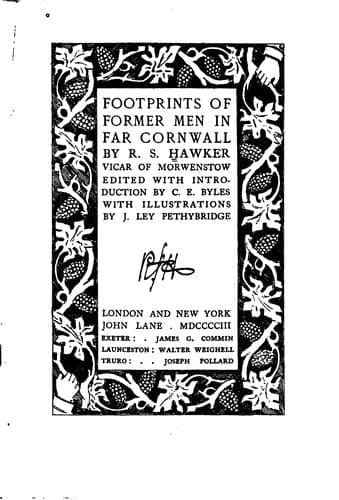
Footprints of Former Men in Far CornwallHawker, Robert Stephen
History
Footprints of Former Men in Far Cornwall
Hawker, Robert Stephen
Cornwall (England : County) -- History
Her voice was heard; her entreaty was fulfilled. They came at the cost
and impulse of Morwenna; they brought and they set up yonder font, with
the carved cable coiled around it in stone, in memory of the vessel
of the fishermen of the East anchored in the Galilæan Sea. They built
there altar and arch, aisle and device in stone. They linked their
earliest structure with Morwenna’s name, the tender and the true;
and so it is that notwithstanding the lapse of ten whole centuries of
English time, at this very day the bourn of many a pilgrim to the West
is the Station of Morwenna, or, in simple and Saxon phrase, Morwenstow.
So runs the quaint and simple legend of our Tamar-side; and so ascend
into the undated era of the ninth or tenth age the early Norman arches,
font, porch, and piscina of Morwenstow church.[8]
The endowment, in abbreviated Latin, still exists in the registry of
the diocese.[9] It records that the monks of St. John at Bridgewater,
in whom the total tithes and glebe-lands of this parish were then
vested, had agreed, at the request of Walter Brentingham, the Bishop
of Exeter, to endow an altar-priest with certain lands, bounded on the
one hand by the sea, and on the other by the Well of St. John of the
Wilderness, near the church. They surrendered, also, for this endowment
the garbæ of two bartons of vills, Tidnacomb[10] and Stanbury, the
altarage, and the small tithes of the parish. But the striking point
in this ancient document is that, whereas the date of the endowment
is A.D. 1296, the church is therein referred to by name as an old
and well-known structure. To such a remote era, therefore, we must
assign the Norman relics of antiquity which still survive, and which,
although enclosed within the walls and outline of an edifice enlarged
and extended at two subsequent periods, have to this day undergone no
material change.
We proceed to enumerate and describe these features of the first
foundation of St. Morwenna,[11] and to which I am not disposed to
assign a later origin than from A.D. 875 to A.D. 1000.
First among these is a fine Norman doorway at the southern entrance
of the present church. The arch-head is semicircular, and it is
sustained on either side by half-piers built in stone, with capitals
adorned with different devices; and the curve is crowned with the
zigzag and chevron mouldings. This moulding is surmounted by a range
of grotesque faces--the mermaid and the dolphin, the whale, and other
fellow-creatures of the deep; for the earliest imagery of the primeval
hewers of stone was taken from the sea, in unison with the great
sources of the Gospel,--the Sea of Galilee, the fishing men who were
to haul the net, and the “catchers of men.” The crown of the arch is
adorned with a richly carved, and even eloquent, device: two dragons
are crouching in the presence of a lamb, and underneath his conquering
feet lies their passive chain.
Public-domain text, read in full here on John Shaqi.
Reviews
Reviews
No reviews yet
Be the first to share your thoughts on this work.
Join the Discussion
Join the discussion
Sign in to leave a comment or review.
Sign InorCreate an account