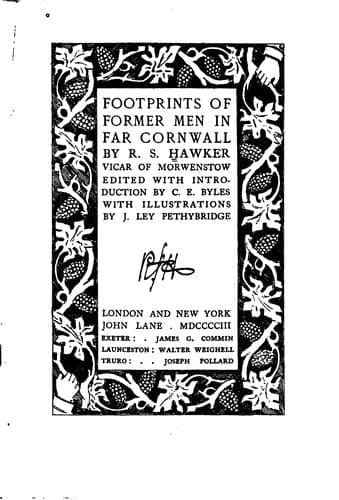
Footprints of Former Men in Far Cornwall — John Shaqi
Footprints of Former Men in Far CornwallHawker, Robert Stephen
History
Footprints of Former Men in Far Cornwall
Hawker, Robert Stephen
Cornwall (England : County) -- History
But it is time for us to unclose the door and enter in. There stands
the font in all its emphatic simplicity. A moulded cable girds it on to
the mother church; and the uncouth lip of its circular rim attests its
origin in times of a rude taste and unadorned symbolism. For wellnigh
ten centuries the Gospel of the Trinity has sounded over this silent
cell of stone, and from the Well of St. John[12] the stream has glided
in, and the water gushed withal, while another son or daughter has
been added to the Christian family. Before us stand the three oldest
arches of the Church in ancient Cornwall. They curve upon piers built
in channelled masonry, a feature of Norman days which presents a
strong contrast with the grooved pillars of solid or of a single stone
in succeeding styles of architecture. The western arch is a simple
semicircle of dunstone from the shore, so utterly unadorned and so
severe in its design that it might be deemed of Saxon origin, were
it not for its alliance with the elaborate Norman decoration of the
other two. These embrace again, and embody the ripple of the sea and
the monsters that take their pastime in the deep waters. But there is
one very graphic “sermon in stone” twice repeated on the curve and on
the shoulder of the arch. Our forefathers called it (and our people
inherit their phraseology) “The Grin of Arius.” The origin of the name
is this. It is said that the final development of every strong and
baleful passion in the human countenance is a fierce and angry laugh.
In a picture of the Council of Nicæa, which is said still to exist, the
baffled Arius is shown among the doctors with his features convulsed
into a strong and demoniac spasm of malignant mirth. Hence it became
one of the usages among the graphic imagery of interior decoration to
depict the heretic as mocking the mysteries with that glare of derision
and gesture of disdain, which admonish and instruct, by the very name
of “The Grin of Arius.” Thence were derived the lolling tongue and
the mocking mouth which are still preserved on the two corbels of
stone in this early Norman work. To this period we must also allot the
piscina,[13] which was discovered and rescued from desecration by the
present vicar.
Public-domain text, read in full here on John Shaqi.
Reviews
Reviews
No reviews yet
Be the first to share your thoughts on this work.
Join the Discussion
Join the discussion
Sign in to leave a comment or review.
Sign InorCreate an account