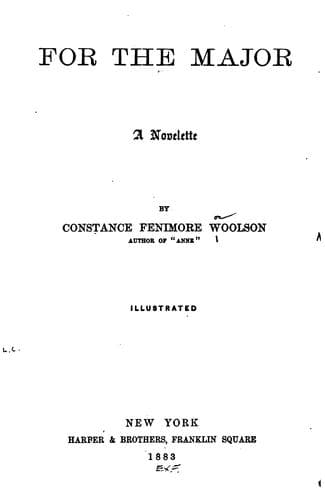
For the Major: A NoveletteWoolson, Constance Fenimore
General
For the Major: A Novelette
Woolson, Constance Fenimore
Psychological fiction; United States -- Social life and customs -- 19th century -- Fiction
But the junior warden did not; his understanding was that there was more
to tell. He drew up his chair again. "Sara Carroll, sir, is a remarkable
girl." (The rector again resigned himself.) "She is, as I may say,
one-ideaed. By that I mean that she has had from childhood one feeling
so predominant that she has fairly seemed to have but the one, which is
her devotion to her father. She had scarcely been separated from him
(save, as it happens, during the very summer when he met and married the
present Madam Carroll) until she was a tall girl of thirteen. This was
in 1861. At that time, before the beginning of actual hostilities, her
uncle, John Chase--he had married her mother's sister--offered to take
her and have her educated with his own daughter Euphemia during the
continuance of the troubled times. For John Chase had always been very
fond of the little Sara; he fancied that she was like his wife. And,
cold New-Englander though he was, he had worshipped his wife (she was
Juliet Witherspoon-Meredith), and seemed to be always thinking of her,
though she had been dead many years. The Major at first refused. But
Madam Carroll, with her exquisite perception, perfect judgment, and
beautiful goodness" (the junior warden always spoke in at least triplets
of admiration when he mentioned the Major's wife), "explained to him the
benefit it would be to Sara. Her own lot was cast with his; she would
not have it otherwise; but in the wandering life she expected to lead,
following his fortunes through the armed South, what advantages in the
way of education should she be able to secure for his little daughter,
who was now of an age to need them? Whereas her uncle, who was very fond
of her, would give her many. The Major at last yielded. And then Sara
was told. Well as they knew her, I think they were both alarmed at the
intensity of her grief. But when the poor child saw how it was
distressing her father, she controlled it, or rather the expression of
it; and to me her self-control was more touching even than her tears had
been, for one could see that her innocent heart was breaking. The
parting was a most pathetic sight--her white cheeks, silence, and
loving, despairing eyes, that never left her father's face--I don't know
when I have been more affected. For I speak from personal remembrance,
sir: _I_ was _there_. Well, that little girl did not see her father
again for four long years. She lived during that time with her uncle at
Longfields--one of those villages of New England with still, elm-shaded,
conscientious streets, silent white houses, the green blinds all closed
across their broad fronts, yet the whole pervaded too, in spite of this
quietude, by an atmosphere of general, unresting _interrogativeness_,
which is, as I may say, sir, _strangling_ to the unaccustomed throat. I
speak from personal remembrance; I have been _personally_ there."
Public-domain text, read in full here on John Shaqi.
Reviews
Reviews
No reviews yet
Be the first to share your thoughts on this work.
Join the Discussion
Join the discussion
Sign in to leave a comment or review.
Sign InorCreate an account