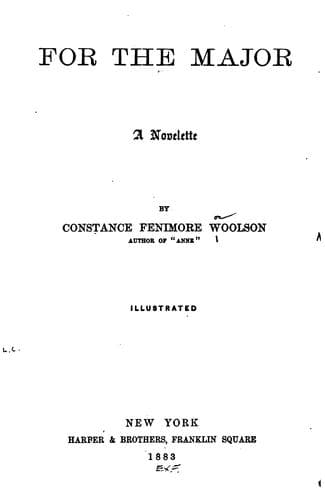
For the Major: A NoveletteWoolson, Constance Fenimore
General
For the Major: A Novelette
Woolson, Constance Fenimore
Psychological fiction; United States -- Social life and customs -- 19th century -- Fiction
"I do not think there is now as much of--of the atmosphere you mention,
as there once was," said the rector, smiling.
"Perhaps not, perhaps not. But when I was there you breathed it in every
time you opened your mouth--like powdered alum. But to ree-vee-nir (I
presume you are familiar with the French expression). In those four
years Sara Carroll grew to womanhood; but she did not grow in her
feelings; she remained one-ideaed. Mind you, I do not, while describing
it, mean in the least to commend such an affection as hers; it was
unreasonable, overstrained. I should be very sorry indeed, extremely
sorry, to see my daughter Honoria making such an idol of me."
The rector, who knew Miss Honoria Ashley, her aspect, voice, and the
rules with which she barred off the days of the poor old junior warden,
let his eyes fall upon his well-scrubbed floor (scrubbed twice a week,
under the personal supervision of Mrs. Rendlesham, by the Rendleshams
maid-of-all-work, Lucilla).
"But the Ashleys are always of a calm and reasonable temperament, I am
glad to say," pursued the warden, "a temperament that might be
classified as judicial. Honoria is judicial. To ree-vee-nir. Sara was
about seventeen when her father bought this place, called the Farms, and
nothing, I suppose, could have kept her from coming home at that time
but precisely that which did keep her--the serious illness of the uncle
to whom she owed so much. His days were said to be numbered, and he
wanted her constantly beside him. I am inclined to suspect that his own
daughter, Euphemia, while no doubt a highly intellectual person, may not
have a--a natural aptitude for those little tendernesses of voice,
touch, and speech--unprescribed if you like, but most dear--which to a
sick man, sir, are beyond rubies, far beyond." The old man's eyes had a
wistful look as he said this; he had forgotten for the moment his
narrative, and even Miss Honoria; he was thinking of Miss Honoria's
mother, his loving little wife, who had been long in paradise.
Public-domain text, read in full here on John Shaqi.
Reviews
Reviews
No reviews yet
Be the first to share your thoughts on this work.
Join the Discussion
Join the discussion
Sign in to leave a comment or review.
Sign InorCreate an account