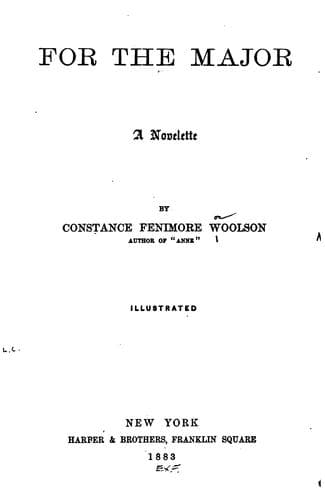
For the Major: A NoveletteWoolson, Constance Fenimore
General
For the Major: A Novelette
Woolson, Constance Fenimore
Psychological fiction; United States -- Social life and customs -- 19th century -- Fiction
He went on with his story, but less briskly. "Sara, therefore, has
remained at Longfields with her uncle. But every six months or so she
has come down as far as Baltimore to meet her father, who has journeyed
northward for the purpose, with Madam Carroll, the expense of these
meetings being gladly borne by John Chase, whose days could not have
been so definitely numbered, after all, as he supposed, since he has
lingered on indefinitely all this time, nearly three years. During the
last year and a half, too, he has been so feeble that Sara could not
leave him, the mere thought of an absence, however short, seeming to
prey upon him. She has not, therefore, seen her father since their last
Baltimore meeting, eighteen months back, as the Major himself has not
been quite well enough to undertake the long journey to Connecticut.
Chase at length died, two months ago, and she has now come home to live.
From what I hear," added the warden, summing up, "I am inclined to think
that she will prove a very fair specimen of a Witherspoon and Meredith,
if not quite a complete Carroll."
"And she could sing the solo for us on Trinity Sunday?" said the rector,
giving the helm a turn towards his anthem.
"She _could_," said the warden, with impartial accent, retreating a
little when he found himself confronted by a date.
"Do you mean if she would?"
"Well, yes. She is rather distant--reserved; I mean, that she seems so
to strangers. You won't find _her_ offering to sing in your choir, or
teach in your Sunday-school, or bring you flowers, or embroider your
book-marks, or make sermon-covers for you, or dust the church, or have
troubles in her mind which require your especial advice; _she_ won't be
going off to distant mission stations on Sunday afternoons, walking
miles over red-clay roads, and jumping brooks, while you go comfortably
on your black horse. She'll be rather a contrast in St. John's just now,
won't she?" And the warden's cough ended in the chuckle.
It was now after ten, and the choir was still practising. Mr. Phipps,
indeed, had proposed going home some time before. But Miss Corinna
Rendlesham having remarked in a general way that she pitied "poor puny
men" whose throats were always "giving out," he knew from that that she
would not go herself nor allow Miss Lucy to go. Now Miss Lucy was the
third Miss Rendlesham, and Mr. Phipps greatly admired her. Ferdinand
Kenneway, wiser than Phipps, made no proposals of any sort (this was
part of his correctness); his voice had been gone for some time, but he
found the places for everybody in the music-books, as usual, and
pretended to be singing, which did quite as well.
"I am convinced that there is some mistake about this second hymn,"
announced Miss Corinna (after a fourth rehearsal of it); "it is the same
one we had only three Sundays ago."
"Four, I think," said Miss Greer, with feeling. For was not this a
reflection upon the rector's memory?
Public-domain text, read in full here on John Shaqi.
Reviews
Reviews
No reviews yet
Be the first to share your thoughts on this work.
Join the Discussion
Join the discussion
Sign in to leave a comment or review.
Sign InorCreate an account