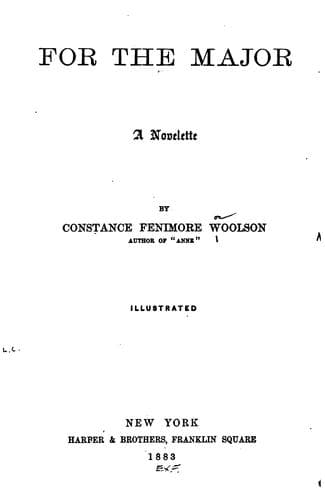
For the Major: A NoveletteWoolson, Constance Fenimore
General
For the Major: A Novelette
Woolson, Constance Fenimore
Psychological fiction; United States -- Social life and customs -- 19th century -- Fiction
Here voices becoming audible outside, the ladies stopped; a moment later
the rector entered. His junior warden was not with him. Having
recollected suddenly the probable expression upon Miss Honoria's face at
this hour, the junior warden had said good-night, paced down the knoll
and up Edgerley Street with his usual careful little step until the safe
seclusion of Ashley Lane was reached, when, laying aside his dignity, he
took its even moonlit centre, and ran, or rather trotted, as fast as he
could up its winding ascent to his own barred front door, where Miss
Honoria let him in, candle in hand, and on her head the ominous cap
(frilled) which was with her the expression of the hour. For Miss
Honoria always arranged her hair for the night and put on this cap at
ten precisely; thus crowned, and wrapped in a singularly depressing gray
shawl, she was accustomed to wait for the gay junior warden, when (as
had at present happened) he had forgotten her wishes and the excellent
clock on her mantel that struck the hours. Meanwhile the rector was
speaking to his choir about the selections for Trinity Sunday. He
addressed Miss Corinna. At rehearsals he generally addressed Miss
Corinna. This was partly due to her martial aspect, which made her seem
the natural leader far more than Phipps or Kenneway, but principally
because, being well over fifty, she was no longer troubled by the
flutter of embarrassment with which the other ladies seemed to be
oppressed whenever he happened to speak to them--timid young things as
they were, all of them under thirty-five.
Miss Corinna responded firmly. The other ladies maintained a gently
listening silence. At length the rector, having finished all he had to
say, glanced at his watch. "Isn't it rather late?" he said.
And they were all surprised to find how late it was.
Like a covey of birds rising, they emerged from the pen made by the
music-stand and organ, and moved in a modest group towards the door. The
rector remained behind for a moment to speak to Bell-ringer Flower. When
he came out, they were still fluttering about the steps and down the
front path towards the gate. "I believe our roads are the same," he
said.
As indeed they were: there was but one road in Far Edgerley. This was
called Edgerley Street, and all the grassy lanes that led to people's
residences turned off from and came back to it, going nowhere else.
There were advantages in this. Some persons had lately felt that they
had not sufficiently appreciated this excellent plan for a town; for if
any friend should happen to be out, paying a visit or taking the air,
sooner or later, with a little patience, one could always meet her (or
him); she (or he), without deliberate climbing of fences, not being
able to escape.
Public-domain text, read in full here on John Shaqi.
Reviews
Reviews
No reviews yet
Be the first to share your thoughts on this work.
Join the Discussion
Join the discussion
Sign in to leave a comment or review.
Sign InorCreate an account