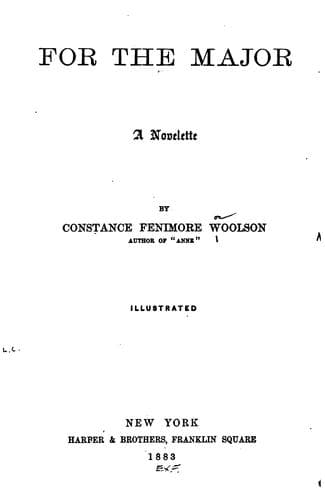
For the Major: A NoveletteWoolson, Constance Fenimore
General
For the Major: A Novelette
Woolson, Constance Fenimore
Psychological fiction; United States -- Social life and customs -- 19th century -- Fiction
The little company from the church now went down the church knoll
towards this useful street. Far Edgerley was all knolls, almost every
house having one of its own, and crowning it. The rector walked first,
with Miss Corinna; the other ladies followed in a cluster which was
graceful, but somewhat indefinite as to ranks, save where Mr. Phipps had
determinedly placed himself beside Miss Lucy Rendlesham, and thus made
one even rank of two. Ferdinand Kenneway walked by himself a little to
the right of the band; he walked not with any one in particular, but as
general escort for the whole. Ferdinand Kenneway often accompanied Far
Edgerley ladies homeward in this collective way. It was considered
especially safe.
Flower, the bell-ringer, left alone on the church steps, looked after
their departing figures in the moonlight. "A riddler it is," he said to
himself--"a riddler, and a myst'rous one, the way all womenkind feels
itself drawed to parsons. I suppose they jedge anything proper that's
clirrycal." He shook his head, locked the church door, and went across
to close the study.
Flower was a Chillawassee philosopher who had formerly carried the mail
on horseback over Lonely Mountain to Fox Gap. Age having dimmed
somewhat his youthful fires, lessening thereby his interest in natural
history, as exemplified by the bears, wolves, and catamounts that
diversified his route, he had resigned his position, judging it to be "a
little too woodsy," on the whole, for a man of his years. He then
accepted the office of bell-ringer of St. John's, a place which he had
been heard to say conferred a dignity second only to that of mails. He
was very particular about this dignity, and the title of it. "Item," he
said, "that I be not a sexton; for sexton be a slavish name for a
free-born mountaineer. Bell-ringer Flower I be, and Bell-ringer Flower
you may call me."
Now the bell of St. John's was but a small one, suspended rustically,
under a little roof of thatch, from the branch of an old elm near the
church door; to ring it, therefore, was but a slight task. But Flower
made it a weighty one by his attitude and manner as he stood on Sunday
mornings, rope in hand, hat off, and eyes devotionally closed, beside
his leafy belfry, bringing out with majestic pull the one little silver
note.
He now re-arranged the chairs in the study, and came upon a framed motto
surrounded by rosebuds in worsted-work, a fresh contribution to the
rector's walls from the second Miss Greer. "Talk about the mil'try--my!
they're nothing to 'em--nothing to these unmarried reverints!" he said
to himself, as he surveyed this new memento. He hung it on the wall,
where there was already quite a frieze of charming embroidery in the way
of texts and woollen flowers. "Item--however, very few of them _is_
unmarried. Undoubted they be drove to it early, in self-defence."
CHAPTER II.
"You are a little tired, Major?"
Public-domain text, read in full here on John Shaqi.
Reviews
Reviews
No reviews yet
Be the first to share your thoughts on this work.
Join the Discussion
Join the discussion
Sign in to leave a comment or review.
Sign InorCreate an account