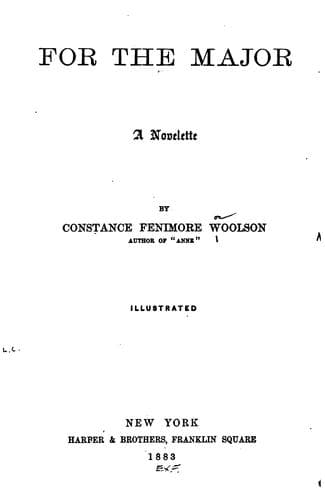
For the Major: A NoveletteWoolson, Constance Fenimore
General
For the Major: A Novelette
Woolson, Constance Fenimore
Psychological fiction; United States -- Social life and customs -- 19th century -- Fiction
"Yes, Mrs. Hibbard of the Mex--I mean, that Mrs. Hibbard's mother was a
Witherspoon. It is right that you should recognize these--ah, these
little distinctions and differences." He brought out the last words in
full, round tones. The Major's voice had always been a fine one.
He was a handsome, soldierly-looking man, tall, broad-shouldered, with
noble bearing, and bold, well-cut features. He was dressed in black,
with broad, stiff, freshly starched white cuffs, and a high standing
collar, round which was folded a black silk cravat that when opened was
three-quarters of a yard square. His thin gray hair, moustache, and
imperial were cut after the fashion affected by the senior officers of
the old army--the army before the war.
"They are not especially interesting in themselves, those two ladies,"
remarked his daughter, taking off her little black bonnet. "Miss Honoria
cares more about one's shoes--whether or not they are dusty enough to
injure her oiled floors--than about one's self; and Mrs. Hibbard talks
all the time about her ducks."
"True, quite true. Those ducks are extremely tiresome. I have had to
hear a great deal about them myself," said the Major, in an injured
tone, forgetting for a moment his military attitude. "What do I know of
ducks? Yet she _will_ talk about them."
"Why should you listen?" said Sara, drawing off her gloves.
"Ah, we must not forget that her mother was a Mex--I mean, a
Witherspoon. It is not necessary for us, for you, to pay many visits, my
daughter; our position does not require it. We--ah--we open our house;
that is enough; our friends come to us; they do not expect us to go to
them."
Sara was now taking off her mantle; he watched to see whether she would
keep it or put it down. She threw it over her arm, and she also took up
her bonnet and gloves. "You will let me come back and read to you,
father?"
"Thank you, my dear; but it is not necessary. I have still another of
Scar's lessons to attend to, and Scar's lessons are important, very
important. There are, besides, various other little things which may
require my attention. In short, my--ah--mornings are at present quite
filled. Besides, reading aloud is very fatiguing, very; and I do not
wish you to fatigue yourself on my account."
"Nothing I was doing for you could fatigue me, father. You don't know
how I have longed to be at home again so that I _could_ do something for
you." She spoke warmly.
The Major looked perturbed. He coughed, and glanced helplessly towards
the door. As if in answer to his look, the door at that moment opened,
and his wife came in.
"Mr. Owen is in the drawing-room, Sara," she said. "Will you go in and
see him, please? I will follow you in a moment. I met him on his way
here, and offered him your vacant place in the carriage."
"He comes rather often, doesn't he?" said Sara, her eyes still on her
father's face.
Public-domain text, read in full here on John Shaqi.
Reviews
Reviews
No reviews yet
Be the first to share your thoughts on this work.
Join the Discussion
Join the discussion
Sign in to leave a comment or review.
Sign InorCreate an account