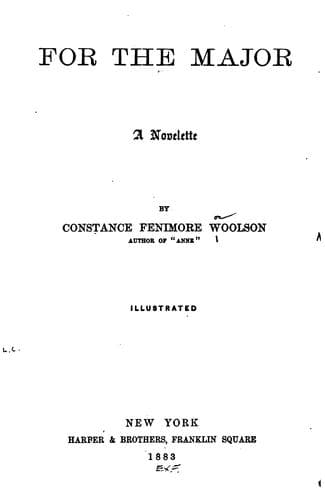
For the Major: A NoveletteWoolson, Constance Fenimore
General
For the Major: A Novelette
Woolson, Constance Fenimore
Psychological fiction; United States -- Social life and customs -- 19th century -- Fiction
"Yes, papa. And this is the next:
'The--knights--are--dust.--Their--good--swords--rust.--Their--souls--are
--with--the--saints--we--trust.' That is too long for one. We will call
it three."
Father and little son completed in this slow way eight of the sentences
the little book contained. It was a small, flat volume in manuscript,
the letters clearly printed with pen and ink. The Major's wife had
prepared it, "from the Major's dictation," she said. "A collection of
the fine old sayings of the world, which he greatly admires, and which
he thinks should form part of the preliminary education of our son."
"Eight. The lesson is finished, papa," said Scar. "If you think I have
done sufficiently well, I may now amuse myself with my dominoes." As he
spoke he replaced the letters in their box, put on the cover, and laid
the manuscript book on the top. Then he drew forward the second box, and
took out his dominoes. He played by himself, one hand against the
other. "You will remember, papa, that my right hand I call Bayard and my
left Roland."
"Yes," answered the Major, looking on with interest.
Roland won the first game. Then the second. "The poor chevalier seems to
have no luck to-day. I must help him a little," said the Major. And he
and Scar played a third game.
While they were thus engaged, with Bayard's fortunes not much improved
as yet, the door opened, and Sara Carroll came in. The Major was sitting
with his spectacles on and head bent forward, in order to read the
numbers on the dominoes; his hand, poised over the game while he
considered his choice, had the shrivelled appearance, with the veins
prominent on the back, which more than anything else betrays the first
feebleness of old age. As his daughter came in he looked up, first
through his spectacles, then, dropping his head a little, over them,
after the peering fashion of old men. But the instant he recognized her
his manner, attitude, even his whole appearance, changed, as if by
magic; his spectacles were off; he had straightened himself, and risen.
"Ah! you have returned?" he said. "Scar had his lessons so well that I
have permitted him to amuse himself with his dominoes for a while, as
you see. You are back rather sooner than you expected, aren't you?"
"We had to postpone our visit to Mrs. Hibbard," said Sara.
The Major's lips formed, "of the Mexican War;" but he did not utter the
syllables aloud, and immediately thereafter seemed to take himself more
vigorously in hand, as it were. He walked to the hearth-rug, and took up
a position there with his shoulders back, his head erect, and one hand
in the breast of his frock-coat. "It is quite proper that you should go
to see those two ladies, my daughter; the Ashleys are connected with the
Carrolls by marriage, though the tie is a remote one, and the mother of
Mrs.--Mrs.--the other lady you were mentioning; her name has just
escaped me--"
"Hibbard," said Sara.
Public-domain text, read in full here on John Shaqi.
Reviews
Reviews
No reviews yet
Be the first to share your thoughts on this work.
Join the Discussion
Join the discussion
Sign in to leave a comment or review.
Sign InorCreate an account