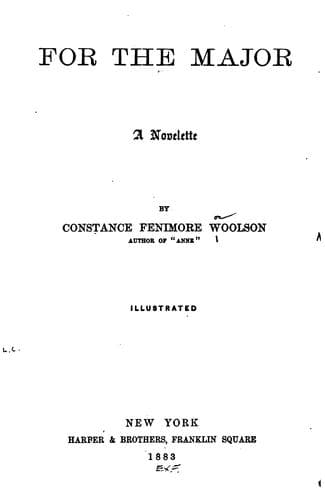
For the Major: A NoveletteWoolson, Constance Fenimore
General
For the Major: A Novelette
Woolson, Constance Fenimore
Psychological fiction; United States -- Social life and customs -- 19th century -- Fiction
"That is because you have had a large variety to choose from, reading as
you do all the poets in the original, from Homer down to--to our sad but
fascinating Lamartine," answered Madam Carroll, looking consideringly
about the room, and finally staying her glance at the toilet-table, upon
which she had expended much time and care. "But our poor Miss Dalley's
life has been harshly narrowed down, narrowed, I may say, to Tasso
alone. For all their small property was swept away by the war, and she
is now obliged to support herself and her mother by dyeing: there is,
fortunately, a good deal of dyeing in Far Edgerley, and so she took it
up. You must have noticed her hands. But we always pretend not to notice
them, because in all other ways she is so lady-like; when she expects to
see any one, she always, and most delicately, wears gloves."
Madam Carroll related this little village history as though she were but
filling an idle moment; but the listener received an impression, none
the less, somewhere down in a secondary consciousness, that she had not
quite done justice to poor Miss Dalley and her aspirations, and that
some time she ought to try to atone for it.
But this secondary consciousness was small: it was small because the
first was so wide and deep, and so filled with trouble--trouble composed
in equal parts of perplexity, disappointment, and grief. She was at
home, and she was not happy. This was a conjunction of conditions which
she had not believed could be possible.
She had never had any disagreements with her father's wife, and she had
been fond of her in a certain way. But the wife had never been to the
daughter more than an adjunct--something added to her father, of
qualifying but not independent importance; a little moon, bright, if you
pleased, and pretty, but still a satellite revolving round its sun. As a
child, she had accepted the new mother upon this basis, because she
could make everything "more pleasant for papa;" and she had gone on
accepting her upon the same basis ever since. Madam Carroll knew this.
She had never quarrelled with it. She and her daughter had filled their
respective positions in entire amity. But now that this daughter had
come home to live, now that she was no longer a school-girl or child,
this was what she had discovered: her father, her idol, had turned from
her, and his wife had gained what his daughter had lost. There could be
no doubt but that he had turned from her; his manner towards her was
entirely changed. He seemed no longer to care to have her with him; he
seemed to avoid her; he was not interested in anything that was
connected with her--he who had formerly been so full of interest; he
never kept up a conversation with her, but let it drop as soon as he
could; he was so--so strange! Although she had now been at home two
weeks, she had scarcely once been alone with him; Madam Carroll had
either been present from the beginning, or she had soon come in; Madam
Public-domain text, read in full here on John Shaqi.
Reviews
Reviews
No reviews yet
Be the first to share your thoughts on this work.
Join the Discussion
Join the discussion
Sign in to leave a comment or review.
Sign InorCreate an account