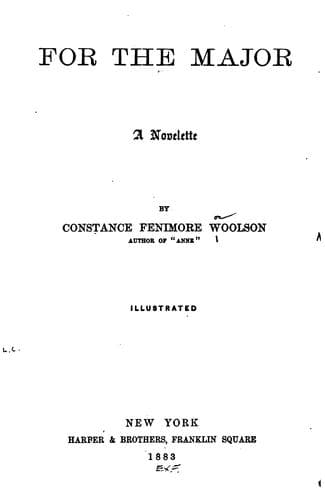
For the Major: A NoveletteWoolson, Constance Fenimore
General
For the Major: A Novelette
Woolson, Constance Fenimore
Psychological fiction; United States -- Social life and customs -- 19th century -- Fiction
Carroll had led the conversation, suggested the topics. The Major had
always been fond of his pretty little wife; but he had also been devoted
to his daughter. The change in him she could not understand; it made her
very unhappy. It would have made her more than that--made her wretched
beyond the possibility of concealment--had there not been in it an
element of perplexity; perplexity which bewildered her, which she could
not solve. For, while her own position and her father's regard for her
seemed completely changed, life at the Farms went on day after day upon
the distinct assumption that there was no change, that everything was
precisely as it always had been. This assumption was not only mentioned,
but insisted upon, the Major's wife often alluding with amusement to
what she called their "dear obstinate old ways."
"The Major ties his cravat precisely as he did twenty-five years ago--he
has acknowledged it to me," she said, glancing at him merrily. "We have
the same things for dinner; we wear the same clothes, or others made
exactly like them; we read the same books because we think them so much
better than the new; we discuss the same old topics for the same
prejudiced old reason. We remain so obstinately unchanged that even Time
himself does not remember who we are. Each year when he comes round he
thinks we belong to a younger generation."
The Major always laughed at these sallies of his wife. "You forget, my
dear, my gray hairs," he said.
"Gray hairs are a distinction," answered Madam Carroll, decisively. "And
besides, Major, they're the only sign of age about you; your figure,
your bearing, are as they always were."
And on Sundays, when he carried round the plate at St. John's, and at
his wife's receptions once in two weeks, this was true.
Sara came out of her troubled revery at the sound of Madam Carroll's
voice. This lady was going on with her subject, as her step-daughter had
not spoken.
"Yes, Caroline Dalley is really very intelligent; she is one of the
subscribers for our _Saturday Review_. You know we subscribe for one
copy--about twelve families of our little circle here--and it goes to
all in turn, beginning with the Farms. The Major selected it; the Major
prefers its tone to that of our American journals as they are at
present. Not that he cares for the long articles. With his--his wide
experience, you know, the _long_ articles could only be tiresome; they
weary him greatly."
"I must have tired him, then, this morning; I read some of the long
articles aloud."
"You had forgotten; you have been so long absent. It was very natural, I
am sure. You will soon recall those little things."
"How can I recall what I never knew? No, mamma, it is not that; it is
the--the change. I am perplexed all the time. I don't know what to do."
Public-domain text, read in full here on John Shaqi.
Reviews
Reviews
No reviews yet
Be the first to share your thoughts on this work.
Join the Discussion
Join the discussion
Sign in to leave a comment or review.
Sign InorCreate an account