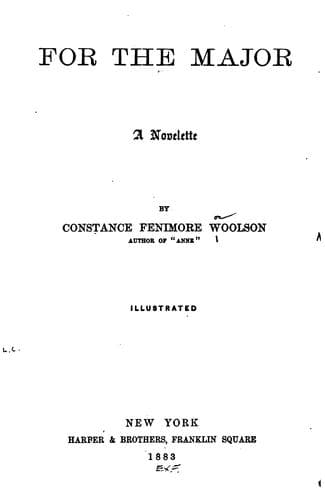
For the Major: A NoveletteWoolson, Constance Fenimore
General
For the Major: A Novelette
Woolson, Constance Fenimore
Psychological fiction; United States -- Social life and customs -- 19th century -- Fiction
Madam Carroll sat down upon the arm of the easy-chair, and drew that
bowed head towards her. No more words were spoken. But now the daughter
understood all. Her perplexity and her trouble were at an end; but they
ended in a grief, as a river ends in the sea--a grief that opened out
all round her, overwhelming the present, and, as it seemed to her then,
the future as well. Madam Carroll said nothing; the bereavement was
there, and the daughter must bear it. No one could save her from her
pain. But the girl knew from this very silence, and the gentle touch of
the hand upon her hair, that all her sorrow was comprehended, her
desolation pitied, understood. For her father had been her idol, her
all; and now he was taken from her. His mind was failing. This was the
bereavement which had fallen upon her heart and life.
CHAPTER III.
AT sunset of the same day Madam Carroll was in her dining-room; she had
changed her dress, and now wore a fresh muslin, with a bunch of violets
in her belt. Sara, coming down the stairs, saw the bright little figure
through the open door; Judith Inches was bringing in the kettle (for
Madam Carroll always made the tea herself), and on the table were one or
two hot dishes of a delicate sort, additions to the usual meal. Sara
recognized in these added dishes the never-failing touch of the
mistress's hand upon the household helm. The four-o'clock dinner had
come and gone, but no summons had been sent to her--that pitiless
summons which in so many households remains inflexible, though stricken
hearts may be longing for solitude, for a respite, however brief, from
the petty duties of the day. Through the long hours of the afternoon
there had been no knock, not so much even as a footstep outside her
door. But now, in the cool of the evening, the one who had thus
protected her seclusion was hoping that she would of her own accord
come down and take again her accustomed place at the family table. Sara
did this. She did more. She had put away the signs of her grief so
completely that, save for an added pallor and the dark half-circle under
her eyes, she was quite herself again. Her soft hair was smooth, her
black dress made less severe by a little white scarf which encircled the
narrow linen collar. Scar was sitting on the bottom stair as she came
down. She put her hand on his head. "Where is papa?" she said.
"Papa is in the library. I think he is not coming out to tea," answered
the child.
"Oh, but we must make him come--the dining-room is so dull without papa.
Let us go and ask him." She took his hand, and they went together to the
library. Madam Carroll, who had heard their words through the open door,
watched them go. She did not interfere. She told Judith Inches to take
back the hot dishes to the kitchen.
Public-domain text, read in full here on John Shaqi.
Reviews
Reviews
No reviews yet
Be the first to share your thoughts on this work.
Join the Discussion
Join the discussion
Sign in to leave a comment or review.
Sign InorCreate an account