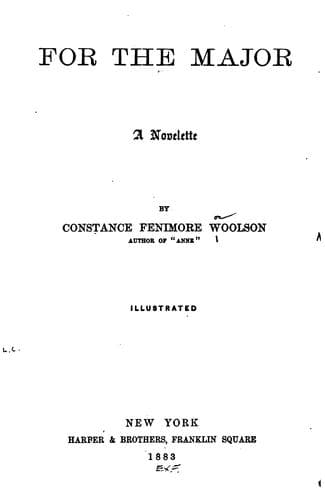
For the Major: A NoveletteWoolson, Constance Fenimore
General
For the Major: A Novelette
Woolson, Constance Fenimore
Psychological fiction; United States -- Social life and customs -- 19th century -- Fiction
"We will ask mamma to give us some," answered Sara. She took his arm,
and Scar took his other hand; thus together they entered the
dining-room.
Madam Carroll welcomed them; but placidly, as though the Major's coming
was a matter of course. Since his daughter's return, however, it had not
been a matter of course: first for this reason, then for that, his meals
had almost always been sent to the library. Now he was tired; and now
the dining-room floor might be damp after Judith Inches'
scrubbing-brush; now there was an east wind, and now there was a west;
or else he was not feeling well, and some one might "drop in," in which
case, as the dining-room opened only into the hall, which was wide, like
a room, he should not be able to escape. In actual fact, however, there
was very little "dropping in" at Carroll Farms, unless one should give
that name to the visits of the rector, Mr. Owen. Once in a while, in the
evening, when the weather was decisively pleasant, the junior warden
came to see them. But all their other acquaintances came to the
receptions, made a brief call upon the first Thursday afternoon
following, and that was all. The sweet little mistress of the mansion
had never uttered one syllable upon the subject, yet each member of the
circle of Far Edgerley society knew as well as though it had been
proclaimed through the town by a herald with a silver trumpet emblazoned
with the Carroll arms, that these bimonthly receptions (which were so
delightful) and the brief following call comprised all the visits they
were expected to pay at Carroll Farms. And surely, when one considered
the great pleasure and also improvement derived from these receptions,
the four visits a month at the Farms were worth more than forty times
four visits at any other residence in the village or its neighborhood.
True, Mrs. Hibbard endeavored to maintain an appearance of importance at
her mansion of yellow wood called Chapultepec; but as General Hibbard
(of the Mexican War) had now been dead eight years, and as his old house
had not been opened for so much as the afternoon sewing society since
his departure, its importance, socially considered, existed only in the
imagination of his relict--which was, however, in itself quite a domain.
Public-domain text, read in full here on John Shaqi.
Reviews
Reviews
No reviews yet
Be the first to share your thoughts on this work.
Join the Discussion
Join the discussion
Sign in to leave a comment or review.
Sign InorCreate an account