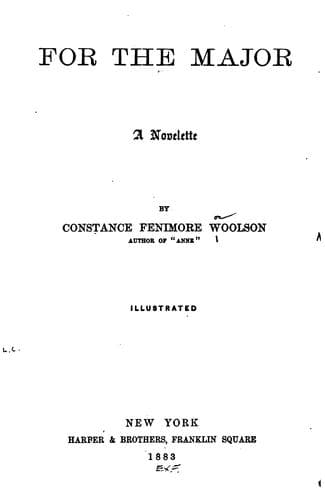
For the Major: A NoveletteWoolson, Constance Fenimore
General
For the Major: A Novelette
Woolson, Constance Fenimore
Psychological fiction; United States -- Social life and customs -- 19th century -- Fiction
Judith Inches, tall and serious, now brought back the hot dishes, Madam
Carroll made the tea (with many pretty little motions and attitudes,
which her husband watched), and the meal began. The Major was in
excellent spirits. He told stories of Sara's childhood, her obstinacy,
her never-failing questions. "She came to me once, Scar," he said, "and
announced that Galileo was a humbug. When I asked her why, she said that
there was good King David, who knew all about astronomy long before he
did; for didn't he say, 'the round world, and they that dwell therein'?
We sang it every Sunday. So that proved plain as day that David knew
that the world was round, and that it moved, and all about it, of
course. Yet here was this old Italian taking everything to himself! Just
like Amerigo Vespucci, another old Italian, who had all America named
after himself, leaving poor Columbus, the real discoverer, with nothing
but 'Hail, Columbia!' to show for it. She announced all this
triumphantly and at the top of her voice, from a window; for I was in
the garden. When I told her that the word 'round,' upon which all her
argument had been founded, was not in the original text, you should have
seen how crest-fallen she was. She said she should never sing that chant
again."
Scar laughed over this story. He did not laugh often, but when he did,
it was a happy little sound, which made every one join in it by its
merry glee.
"I am afraid I was a very self-conceited little girl, Scar," his sister
said.
As the meal went on, the Major's manner grew all the time more easy. His
eyes were no longer restless. His old attention returned, too, in a
measure; he kept watch of his wife's plate to ask if she would not have
something more; he remembered that Sara preferred bread to the beat
biscuit, and placed it near her. The meal ended, they went back to the
library. Sara found her old copy of "Good Queen Bertha's Honey-Broth,"
and she and her father looked at the pictures together, as well as at
those of "Robinson Crusoe." Each had its association, a few recalled by
him, but many more by her. After Scar had gone to bed, and the books had
been laid aside, she still sat there talking to him. She talked of her
life at Longfields, telling stories in connection with it--stories not
long--bright and amusing. The Major's wife meanwhile sat near them,
sewing; she sat with her back to the lamp, in order that the light might
fall over her shoulder upon the seam. The light did the work she
assigned to it, but it also took the opportunity to play over her curls
in all sorts of winsome ways, to gleam on her thimble, to glide down her
rosy muslin skirt, and touch her little slipper. She said hardly
anything; but, as they talked on, every now and then she looked up
appreciatively, and smiled. At last she folded up her work, replacing it
in her neat rose-lined work-basket; then she sat still in her low chair,
with her feet on a footstool, listening.
Public-domain text, read in full here on John Shaqi.
Reviews
Reviews
No reviews yet
Be the first to share your thoughts on this work.
Join the Discussion
Join the discussion
Sign in to leave a comment or review.
Sign InorCreate an account