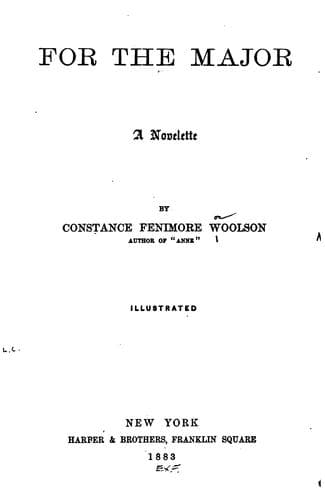
For the Major: A NoveletteWoolson, Constance Fenimore
General
For the Major: A Novelette
Woolson, Constance Fenimore
Psychological fiction; United States -- Social life and customs -- 19th century -- Fiction
The old clock, with its fierce gilt corsair climbing over a glass rock,
struck ten.
"Bed-time," said Sara, pausing.
"Not for me," observed the Major. "My time for sleep is always brief;
five or six hours are quite enough."
"I remember," said his daughter. And the memory, as a memory, was a true
one. Until recently the Major's sleep had been as he described it. He
had forgotten, or rather he had never been conscious of, the long nights
of twelve or thirteen hours' rest which had now become a necessity to
him.
"I am afraid I am not like you, father. I am very apt to be sleepy about
ten," said Sara. "And I suspect it is the same with mamma."
Madam Carroll did not deny this assertion. The Major, laughing at the
early somnolence of the two ladies, rose to light a candle for his
daughter, in the old way. As she took it, and bent to kiss her
stepmother good-night, Madam Carroll's eyes met hers, full of an
expression which made them bright (ordinarily they were not bright, but
soft); the expression was that of warm congratulation.
The next day dawned fair and cloudless--Trinity Sunday. The mountain
breeze and the warm sun together made an atmosphere fit for a heaven. On
the many knolls of Far Edgerley the tall grass, carrying with it the
slender stalks of the buttercups, was bending and waving merrily; the
red clover, equally abundant, could not join in this dance, because it
had crowded itself so greedily into the desirable fields that all that
its close ranks could do was to undulate a little at the top, like a
swell passing over a pond. Madam Carroll, the Major, and Scar were to
drive to church as usual, in the equipage. Sara had preferred to walk.
She started some time before the hour for service, having a fancy to
stroll under the churchyard pines for a while by herself. These pines
were noble trees; they had belonged to the primitive forest, and had
been left standing along the northern border of the churchyard by the
Carroll who had first given the land for the church a hundred years
before. The ground beneath them was covered with a thick carpet of their
own brown aromatic needles. There were no graves here save one, of an
Indian chief, who slept by himself with his face towards the west, while
all his white brethren on the other side turned their closed eyes
towards the rising sun. It was a beautiful rural God's-acre, stretching
round the church in the old-fashioned way, so that the shadow of the
cross on the spire passed slowly over all the graves, one by one, as the
sun made his journey from the peak of Chillawassee across to Lonely
Mountain, behind whose long soft line he always sank, and generally in
such a blaze of beautiful light that the children of the village grew up
in the vague belief that the edge of the world must be just there, that
there it rounded and went downward into a mysterious golden atmosphere,
in which, some day, when they had wings, they, too, should sport and
float like birds.
Public-domain text, read in full here on John Shaqi.
Reviews
Reviews
No reviews yet
Be the first to share your thoughts on this work.
Join the Discussion
Join the discussion
Sign in to leave a comment or review.
Sign InorCreate an account