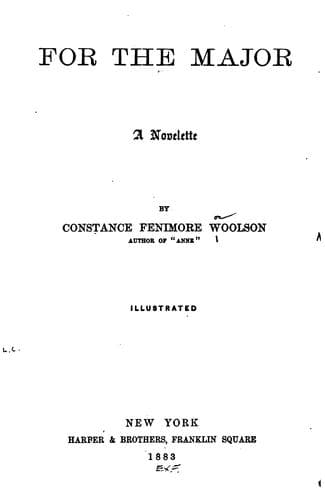
For the Major: A NoveletteWoolson, Constance Fenimore
General
For the Major: A Novelette
Woolson, Constance Fenimore
Psychological fiction; United States -- Social life and customs -- 19th century -- Fiction
But after a while Love rose, and turned back this tide. The sharp
personal pain, the bitter loneliness, gave way to a new tenderness for
the stricken man himself. Evidently he was at times partly conscious of
this lethargy which was fettering more and more his mental powers, for
he exerted himself, he tried to remember, he tried to be brighter, to
talk in the old way. And who could tell but that he perceived his
failure to accomplish this? Who could tell, when he was silent so often,
sitting with his eyes on the carpet, that he was not brooding over it
sadly? For a man such as he had been, this must be deep suffering--deep,
even though vague--like the sensation of falling in a dream, falling
from a height, and continuing to fall, without ever reaching bottom.
Probably he did not catch the full reality; it constantly eluded him;
yet every now and then some power of his once fine mind might be awake
long enough to make him conscious of a lack, a something that gave him
pain, he knew not why. As she thought of this, all her heart went out to
him with a loving, protecting tenderness which no words could express;
she forgot her own grief in thinking of his, and her trouble took the
form of a passionate desire to make him happy; to keep even this dim
consciousness always from him, if possible; to shield him from contact
with the thoughtless and unfeeling; to so surround his life with love,
like a wall, that he should never again remember anything of his loss,
never again feel that inarticulate pain, but be like one who has entered
a beautiful, tranquil garden, to leave it no more.
This morning, under the pines, she was thinking of all this, as she
walked slowly to and fro past the Indian's grave. Flower came out to
ring his first bell. His "first bell" was unimportant, made up of
short, business-like notes; he rang it in his working jacket, an old
mountain homespun coat, whose swallow-tails had been cut off, so that it
now existed as a roundabout. But when, twenty minutes later, he issued
forth a second time, he was attired in a coat of thin but shining black,
with butternut trousers and a high pink calico vest. Placing his hat
upon the ground beside him, he took the rope in his hand, made a solemn
grimace or two to get his mouth into position, and then, closing his
eyes, brought out with gravity the first stroke of his "second bell."
His second bell consisted of dignified solo notes, with long pauses
between. Flower's theory was that each of these notes echoed resonantly
through its following pause. But as the bell of St. John's was not one
of size or resonance, he could only make the pauses for the echoes which
should have been there.
Public-domain text, read in full here on John Shaqi.
Reviews
Reviews
No reviews yet
Be the first to share your thoughts on this work.
Join the Discussion
Join the discussion
Sign in to leave a comment or review.
Sign InorCreate an account