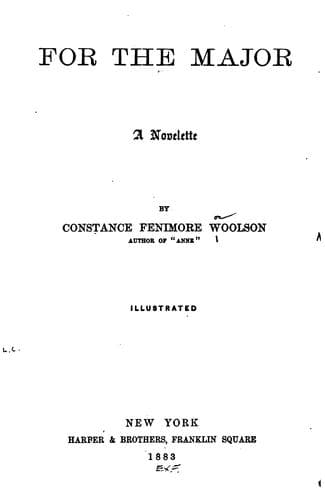
For the Major: A NoveletteWoolson, Constance Fenimore
General
For the Major: A Novelette
Woolson, Constance Fenimore
Psychological fiction; United States -- Social life and customs -- 19th century -- Fiction
As the first note of this second bell sounded from the elm, all the
Episcopal doors of Far Edgerley opened almost simultaneously, and forth
came the congregation, pacing with Sunday step down their respective
front paths, opening their gates, and proceeding decorously towards St.
John's in groups of two or three, or a family party of father, mother,
and children, the father a little in advance. They all arrived in good
season, passed the semi-unconscious Flower ringing his bell, and
entered the church. Next, after an interval, came "clatter," "clatter:"
they knew that "the equipage" was coming up the hill. Then "clank,"
"clank:" the steps were down.
All now turned their heads, but only to the angle which was considered
allowable--less than profile, about a quarter view of the face, with a
side glance from one eye. To them, thus waiting, now entered their
senior warden, freshly dressed, gloved, carrying his hat and his large
prayer-book; and as he walked up the central aisle, a commanding figure,
with noble head, gray hair, and military bearing, he was undoubtedly a
remarkably handsome, distinguished-looking man.
Behind him, but not too near, came the small figures of Madam Carroll
and Scar, the lady in a simple summer costume of lavender muslin, with
many breezy little ruffles, and lavender ribbons on her gypsy hat, the
delicate hues causing the junior warden to exclaim (afterwards) that she
looked like "a hyacinth, sir; a veritable hyacinth!" Scar, in a black
velvet jacket (she had made it for him out of an old cloak), carrying
his little straw hat, held his mother's hand. The Major stopped at his
pew, which was the first, near the chancel; he turned, and stood waiting
ceremoniously for his wife to enter. She passed in with Scar; he
followed, and they took their seats. Then the congregation let its chin
return to a normal straightness, the bell stopped, Alexander Mann (to
use his own expression) "blew up," and Miss Millie began.
Public-domain text, read in full here on John Shaqi.
Reviews
Reviews
No reviews yet
Be the first to share your thoughts on this work.
Join the Discussion
Join the discussion
Sign in to leave a comment or review.
Sign InorCreate an account