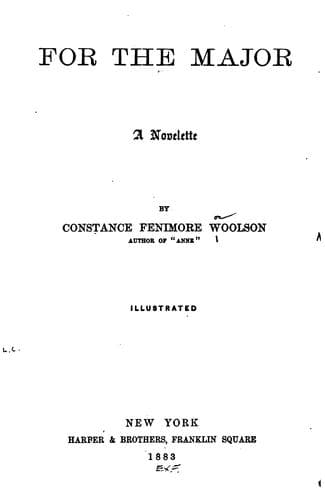
For the Major: A NoveletteWoolson, Constance Fenimore
General
For the Major: A Novelette
Woolson, Constance Fenimore
Psychological fiction; United States -- Social life and customs -- 19th century -- Fiction
Miss Carroll came in a minute or two late. But there was no longer much
curiosity about Miss Carroll. It was feared that she was "cold;" and it
was known that she was "silent;" she had almost no "conversation." Now,
Far Edgerley prided itself upon its conversation. It never spoke of its
domestic affairs in company; light topics of elegant nature were then in
order. Mrs. Greer, for instance, had Horace Walpole's Letters--which
never failed. Other ladies preferred the cultivation of flowers, garden
rock-work, and their bees (they allowed themselves to go as far as bees,
because honey, though of course edible, was so delicate). Mrs.
Rendlesham, who was historical, had made quite a study of the
characteristics of Archbishop Laud. And the Misses Farren were greatly
interested in Egyptian ceramics. Senator Ashley, among many subjects,
had also his favorite; he not infrequently turned his talent for talking
loose upon the Crimean War. This was felt to be rather a modern topic.
But the junior warden was, on the whole, the most modern man they had.
Too modern, some persons thought.
CHAPTER IV.
July passed, and August began. Sara Carroll had spent the weeks in
trying to add to her father's comfort, and trying also to alter herself
so fully, when with him, that she should no longer be a burden upon his
expectation, a care upon his mind. In the first of these attempts she
was and could be but an assistant, and a subordinate one, filling the
interstices left by Madam Carroll. For the Major depended more and more
each day upon his little wife. Her remarks always interested him, her
voice he always liked to hear; he liked to know all she was doing, and
where she went, and what people said to her; he liked to look at her;
her bright little gowns and sunny curls pleased his eye, and made him
feel young again, so he said. He had come, too, to have a great pride in
her, and this pride had grown dear to him; it now made one of the
important ingredients of his life. He liked to mention what a fine
education she had had; he liked to say that her mother had been a
"Forster of Forster's Island," and that her father was an Episcopal
clergyman who had "received his education at Oxford." He thought little
Scar had "English traits," and these he enumerated. He had always been a
proud man, and now his pride had centred itself in her. But if his pride
was strong, his affection was stronger; he was always content when she
was in the room, and he never liked to have her long absent. When he was
tired, she knew it; he was not obliged to explain. All his moods she
comprehended; he was not obliged to define them. And when he did appear
in public, at church on Sundays, or at her receptions, it was she upon
whom he relied, who kept herself mentally as well as in person by his
side, acting as quick-witted outrider, warding off possible annoyance,
guiding the conversation towards the track he preferred, guarding his
Public-domain text, read in full here on John Shaqi.
Reviews
Reviews
No reviews yet
Be the first to share your thoughts on this work.
Join the Discussion
Join the discussion
Sign in to leave a comment or review.
Sign InorCreate an account