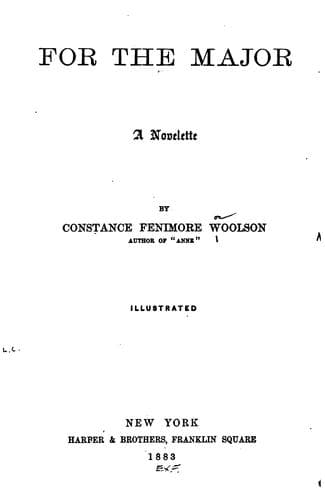
For the Major: A NoveletteWoolson, Constance Fenimore
General
For the Major: A Novelette
Woolson, Constance Fenimore
Psychological fiction; United States -- Social life and customs -- 19th century -- Fiction
This first little beginning of happiness grew and budded like a flower;
for now more and more her father asked for her, wanted her with him; he
took her arm as they walked about the grounds, and she felt as glad and
proud as a child because she was tall enough and strong enough to be of
real use to him. She remembered the desolation of those hours when she
had thought that she should never be of use to him again, should have no
place beside him, should be to him only a care and a dread; thinking of
this, she was very thankfully happy. When she could do something for
him, and he was pleased, it seemed to her almost as if she had never
loved him so much; for, added to her old strong affection, there was now
that deep and sacred tenderness which fills the heart when the person
one loves becomes dependent--trustingly dependent, like a little
child--upon one's hourly thought and care.
The rector of St. John's had continued those visits which Miss Carroll
had criticised as too frequent. When he came he seldom saw his senior
warden; but the non-appearance was sufficiently excused by the state of
the senior warden's health, as well as made up for by the presence of
his wife. For Madam Carroll was charming in her manner to the young
clergyman, always giving him the kind of welcome which made him feel
sure that she was glad to see him, and that she wished him to come
again. As he continued to come, it happened now and then that the
mistress of the house would be engaged, and unable to see him. Perhaps
she was reading to the Major from his _Saturday Review_; and this was
something which no one else could do in the way he liked. She alone knew
how to select the items he cared to hear, and, what was more important,
how to leave the rest unread; she alone knew how to give in a line an
abstract that was clear to him, and how to enliven the whole with gay
little remarks of her own, which, she said, he must allow her--a
diversion for her smaller feminine mind. The Major greatly valued his
_Saturday Review_; he would have been much disturbed if deprived of the
acquaintance it gave him with the events of the day. Not that he enjoyed
listening to it; but when it was done and over for that week, he had the
sensation of satisfaction in duty accomplished which a man feels who has
faced an east wind for several hours without loss of optimism, and
returned home with a double appreciation of his own pleasant library and
bright fire. One's life should not be too personal, too easy; there
should be a calm consideration of public events, a general knowledge of
the outside world--though that outside world, tending as it did at
present too much towards mere utilitarian interests, was not especially
interesting; thus spoke the Major at the receptions (with that week's
_Saturday_ fresh in his memory), as he alluded briefly to the European
news. For they never discussed American news at the receptions; they
never came farther westward, conversationally, than longitude
Public-domain text, read in full here on John Shaqi.
Reviews
Reviews
No reviews yet
Be the first to share your thoughts on this work.
Join the Discussion
Join the discussion
Sign in to leave a comment or review.
Sign InorCreate an account