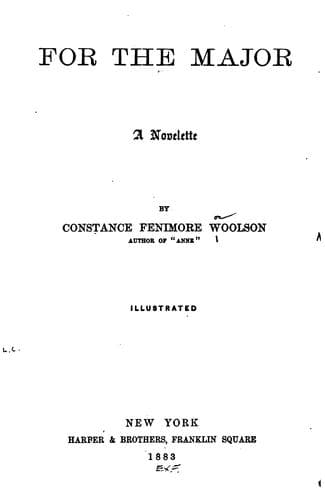
For the Major: A NoveletteWoolson, Constance Fenimore
General
For the Major: A Novelette
Woolson, Constance Fenimore
Psychological fiction; United States -- Social life and customs -- 19th century -- Fiction
twenty-five, reckoned, of course, from Greenwich. In 1868 there was a
good deal of this polite oblivion south of the Potomac and Cumberland.
When, therefore, Mr. Owen happened to call at a time when Madam Carroll
was engaged, Miss Carroll was obliged to receive him. She did not
dislike him (which was fortunate; she disliked so many people!), but she
did not care to see him so often, she said. He talked well, she was
aware of that; he had gone over the entire field of general subjects
with the hope, as it seemed, of finding one in which she might be
interested. But as she was interested in nothing but her father, and
would not talk of him now, save conventionally, with any one, he found
her rather unresponsive.
His congregation thought her, in addition, cold. Not a few of them had
mentioned to him this opinion. But there was something in Sara
Carroll's face which seemed to Owen the reverse of cold, though he could
not deny that to him personally she was, if not precisely wintry, at
least as neutral as a late October day, when there is neither sun to
warm nor wind to vivify the gray, still air. Yet he continued to come to
the Farms. His liking for the little mistress of the house was strong
and sincere. He thought her very sweet and winning. He found there, too,
an atmosphere in which he did not have to mount guard over himself and
his possessions--an atmosphere of pleasant welcome and pleasant words,
but both of them unaccompanied by what might have been called, perhaps,
the acquisitiveness which prevailed elsewhere. No one at the Farms
wanted him or anything that was his, that is, wanted it with any
tenacity; his time, his thoughts, his opinions, his approval or
disapproval, his ideas, his advice, his personal sympathy, his especial
daily guidance, his mornings, his evenings, his afternoons, his favorite
books, his sermons in manuscript--all these were considered his own
property, and were not asked for in the large, low-ceilinged
drawing-room where the Major's wife and daughter, one or both, received
him when he came. They received him as an equal (Miss Carroll as a not
especially important one), and not as a superior, a being from another
world; though Madam Carroll always put enough respect for his rector's
position into her manner to make him feel easy about himself and about
coming again.
Public-domain text, read in full here on John Shaqi.
Reviews
Reviews
No reviews yet
Be the first to share your thoughts on this work.
Join the Discussion
Join the discussion
Sign in to leave a comment or review.
Sign InorCreate an account