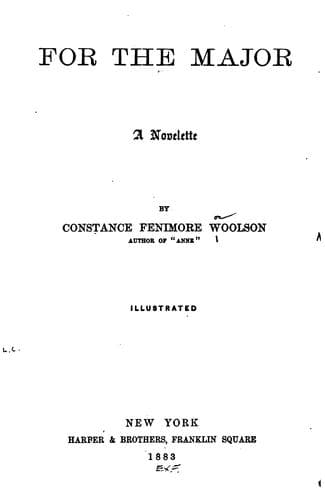
For the Major: A NoveletteWoolson, Constance Fenimore
General
For the Major: A Novelette
Woolson, Constance Fenimore
Psychological fiction; United States -- Social life and customs -- 19th century -- Fiction
The American Hebe talked with much animation; Far Edgerley admired her
more than ever. After the Major had retired she was even gay; the junior
warden having lost the spray of sweet-pea from his button-hole, with
charming sportiveness she called him to her and replaced it with one of
her pink roses.
Meanwhile Mr. Dupont was conducting himself after his usual fantasied
fashion. He strolled about and leaned against the walls--a thing never
done in Far Edgerley, on account of the paper; he stared at the
head-dress of Mrs. General Hibbard, an impressive edifice of black lace
and bugles; he talked a little to Miss Lucy Rendlesham, to the rage of
Phipps; he turned his back on F. Kenneway; and he laughed at the
poetical quotations of Mrs. Greer. And then he made no less than six
profound bows before Miss Corinna, the dignified leader of St. John's
choir.
He bowed whenever he met her, stopping especially for the purpose,
drawing his feet together, and bending his head and body to an angle
heretofore unwitnessed in that community. Miss Corinna, in chaste black
silk, became at last, martial though she was, disconcerted by this
extreme respect. She could not return it properly, because, most
unfortunately, as she had always thought, the days of the courtesy, the
only stately salutation for a lady, were gone by. She bowed as
majestically as she could. But when it came to the seventh time, she
said to her second sister, "Really, Camilla, his attentions are becoming
too pressing. Let us retire." So they retired--to the wall. But even
here they were not secure, Dupont discovering their retreat, and coming
by expressly every now and then to bestow upon the stately maiden
another salute.
Towards the end of the evening--or rather, of the reception--he sang,
accompanying himself upon the guitar. His guitar had a long loop of red
ribbon attached to it; Miss Carroll surveyed it and its owner with
coldest eye, as, seated upon a low ottoman in the centre of the room, he
began what she had called his "little songs." His songs were, in truth,
always brief; but they were not entirely valueless, in spite of her
prejudice against them. They had a character of their own. Sometimes
they contained minor strains too old for Far Edgerley to remember, the
wild, soft, plaintive cadences of the Indian women of tribes long gone
towards the setting sun, of the first African slaves poling their
flatboats along the Southern rivers. And sometimes they were love-songs,
of a style far too modern for the little, old-fashioned town to
comprehend. Dupont's voice was a tenor, not powerful, but deliciously,
sensuously sweet. As he sat there singing, with his large, bold dark
eyes roving about the room, with his slender dark fingers touching the
strings, with his black moustache, waxed at the ends, the gleam of his
red handkerchief, and the red flower in his coat, he seemed to some of
the ladies present romantically handsome. To Sara Carroll he seemed a
living impertinence.
Public-domain text, read in full here on John Shaqi.
Reviews
Reviews
No reviews yet
Be the first to share your thoughts on this work.
Join the Discussion
Join the discussion
Sign in to leave a comment or review.
Sign InorCreate an account