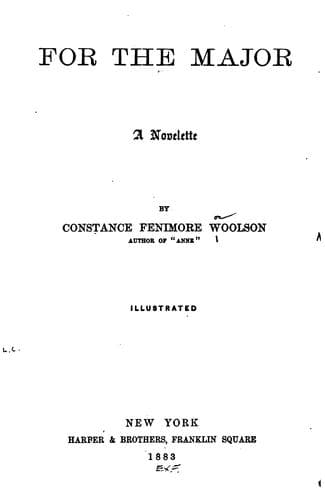
For the Major: A NoveletteWoolson, Constance Fenimore
General
For the Major: A Novelette
Woolson, Constance Fenimore
Psychological fiction; United States -- Social life and customs -- 19th century -- Fiction
"Why should not one pity him a little?--a young man who is so alone in
the world, as he tells us he is, not strong in health, and often moody.
Then, too, there is his genius."
"I am tired of his genius. I do not believe in his genius. There is no
power in it. Always a 'little song!' A 'little song!' His little songs
are too sweet; they have no force."
"Do you wish him to shout?"
"I wish him to take himself elsewhere. I am speaking freely, mamma; for
I have noticed that you seem to like him."
"He is a variety--that is the explanation; we have so little variety
here. But I do like him, Sara, or, rather, I like his songs. To me they
are very beautiful."
[Illustration: "HE CAME OFTEN TO THEIR FLOWER GARDEN."]
Nothing more was said on either side. Sara had announced her dislike,
and it had been ignored; her regard for Madam Carroll kept her from
again expressing the feeling.
The present reception was considered an especially delightful one. One
reason for this was that Madam Carroll had altered her hours; instead of
from five to eight, they were now from eight to ten. True, the time was
shorter; but this was compensated for by the change from afternoon to
evening. For choice as had been the tone of elegant culture which had
underlain these social meetings heretofore, there was no doubt but that
they gained in the element of gayety by being deferred to candle-light.
The candles inspired everybody; it was felt to be more festal. The
ladies wore flowers in their hair, and Ferdinand Kenneway came out in
white gloves. The Major, too, had not appeared so well all summer as he
did this evening; every one remarked it. Not that the Major did not
always appear well. "He is, and always has been, the first gentleman of
our state. But to-night, how peculiarly distinguished he looks! His gray
hair but adds to his noble appearance--don't you think so?--his gray
hair and his wounded arm? And dear Madam Carroll, too, when have you
seen her look so bright?"
Thus the ladies. But the daughter of the house, meanwhile, had never
been more silent. To-night she merited, without doubt, their adjective
"cold." She had not been able to be of much use to her father this
evening. During the three quarters of an hour he had given to his guests
Madam Carroll had not left him; together they had gone through the
rooms, exchanging greetings, holding short conversations, inquiring
after the health of the absent. As had been remarked, the little wife
looked very bright. She had more color than usual; her complexion had
never had, they said, a more exquisite bloom. She was dressed in white,
with a large bunch of pink roses fastened in her belt, and as she stood
by the side of her tall, gray-haired husband she looked, the junior
warden declared, like "a Hebe." And then he carefully explained that he
meant an American Hebe of delicate outlines, and not the Hebe of the
ancient Greeks--"who always weighed two hundred."
Public-domain text, read in full here on John Shaqi.
Reviews
Reviews
No reviews yet
Be the first to share your thoughts on this work.
Join the Discussion
Join the discussion
Sign in to leave a comment or review.
Sign InorCreate an account