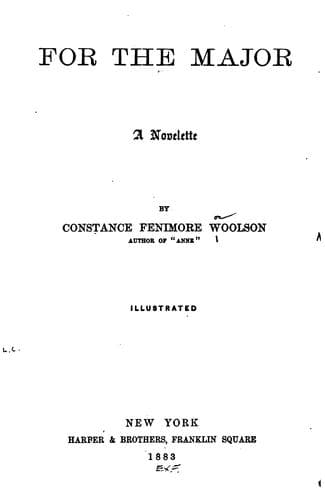
For the Major: A NoveletteWoolson, Constance Fenimore
General
For the Major: A Novelette
Woolson, Constance Fenimore
Psychological fiction; United States -- Social life and customs -- 19th century -- Fiction
And Miss Carroll was so displeased with the scene within that she
consented to withdraw to the scene without; and there they remained as
long as the singing lasted. They walked up and down the broad piazza; he
talked about the mountain scenery, and the waterfalls. She did not
appear to be much interested in them. Her companion, however, was not so
much chilled by this manner of hers as he had sometimes been; he had had
a glimpse behind it.
CHAPTER V.
Early in the week following the reception, Frederick Owen learned that
Dupont was about to take his departure from Far Edgerley, and with no
expectation of returning. This was good news. He was beginning to have
the feeling that the fellow would never go away, that he and his guitar
would become a permanent feature of Madam Carroll's receptions, his
lounging figure under the cream-colored umbrella a daily ornament of the
centre of Edgerley Street. Was he really, then, going? It seemed too
good to be true. But the tidings had been brought by Miss Dalley, who
was both good and true, and who was accurate as well; she had the very
hour--"On Friday, at nine."
"Hangman's day!" thought Owen, with satisfaction, doing his thinking
this time with the remnants of boyhood feelings; for though he was in
his third decade--the beginning of it--and a clergyman, the boy in him
was by no means entirely outgrown. Miss Dalley had come to return a
book, Longfellow's "Outre Mer," and to borrow anything he might have
about Ferrara.
"I was so much interested in our American poet's description of the
Italian poet's grave, on the Janiculum," she said. "It was such a
touching passage, and it contained this truly poetical sentence: 'He
sleeps midway between his cradle at Sorrento and his dungeon at
Ferrara.' I can never go in _person_, Mr. Owen; Fate has denied me that.
But I can think of the inscription, which Longfellow gives: 'Torquati
Tasso ossa hic jacet,' and be there in _mind_."
She had called it "hic jacket." "Jacent, I think," said the rector,
gently.
"Yes, certainly; that is what I meant--jacinth," said Miss Dalley,
correcting herself. "A beautiful word, is it not? And so appropriate,
too, for a poet's grave, mentioned, as it is, in Revelations!"
On Friday Dupont really did go. The rector himself saw him pass in the
high red wagon of the Washington Inn on his way down the mountain to the
lower town, the eastward-bound stage, and thence--wherever he pleased,
the gazer thought, so long as he did not return. But although the rector
gave this vagueness to the musician's destination, it was understood in
other quarters that he was going back to the West India Islands--"where
he used to live, you know."
"Upon which one did he live?" asked the junior warden. "There are about
fifty thousand of them, large and small; he can't have lived on them
all."
"For my part, I think him _quite_ capable of it," answered Miss Honoria,
grimly.
Public-domain text, read in full here on John Shaqi.
Reviews
Reviews
No reviews yet
Be the first to share your thoughts on this work.
Join the Discussion
Join the discussion
Sign in to leave a comment or review.
Sign InorCreate an account