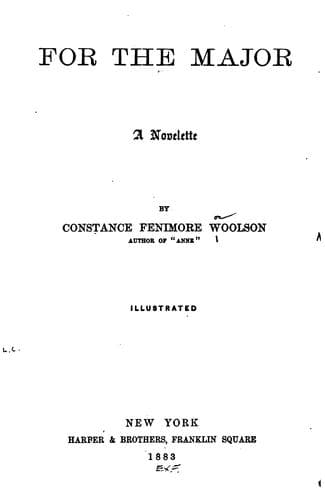
For the Major: A NoveletteWoolson, Constance Fenimore
General
For the Major: A Novelette
Woolson, Constance Fenimore
Psychological fiction; United States -- Social life and customs -- 19th century -- Fiction
Having seen the musician depart, Owen jumped on his horse and went off
to one of his mission stations far up among the crags of Lonely
Mountain. For, not content with a rector's usual duties, all of which he
attended to with a modern promptness unknown in the days of good old
Parson Montgomery, he had established mission stations at various points
in the mountains above Far Edgerley. Wherever there were a few
log-houses gathered together, there he held services, or started a
Sunday-school. He was by far the most energetic rector the parish of St.
John in the Wilderness had ever had; so much so, indeed, that the parish
hardly knew how to take his energy, and thought that he was perhaps
rather too much in the wilderness--more than necessity demanded or his
bishop required. Miss Honoria Ashley had even called these journeyings
of his "itinerant;" but Miss Honoria was known to disapprove, on general
principles, of everything the rector did: she had once seen him wearing
a sack-coat.
On this particular Friday he was out all day among the peaks, close up
under the sky. Coming down at sunset, and entering Edgerley Street,
with its knolls and flower-gardens and rambling old houses, his home
seemed to him a peaceful and pleasant one. And then, as he passed
Carroll Farms, he became conscious that the cause for its seeming
especially peaceful to him this evening was the absence of the intruder,
that man from another world, who was no longer there to contaminate its
sweet, old-fashioned simplicity with his dubious beauty, his dangerous
character, and his enchanting voice. For Owen believed that the
musician's character was dangerous; his face bore the marks of
dissipation, and though indolent, and often full of gay good-nature, he
had at times a reckless expression in his eyes. Nothing deterred him
from amusing himself; and probably, in the same way, nothing would deter
him from any course towards which he should happen to feel an
inclination. He was not dangerous by plan or calculation; he was
dangerous from the very lack of them. He was essentially erratic, and
followed his fancies, and no one could tell whither they would lead him.
But he might have been all this, and the clergyman would still have felt
able to guard his parish and people from any harm his presence might do
them, had it not been for the favor shown him by Madam Carroll. This had
been a blow to Owen. He said to himself that the gentle lady's love of
music had blinded her judgment, and carried her astray. It was a
satisfaction that Miss Carroll's judgment remained unblinded. But it was
greatest satisfaction of all that the man was gone; he congratulated
himself upon this anew as he rode by the gateway of the Farms.
Public-domain text, read in full here on John Shaqi.
Reviews
Reviews
No reviews yet
Be the first to share your thoughts on this work.
Join the Discussion
Join the discussion
Sign in to leave a comment or review.
Sign InorCreate an account