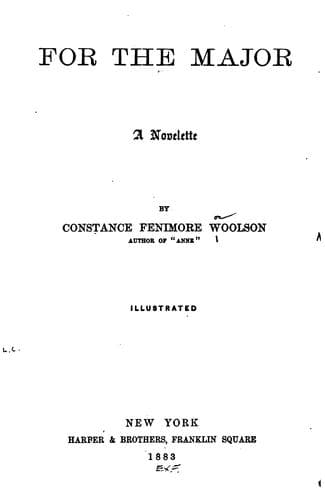
For the Major: A NoveletteWoolson, Constance Fenimore
General
For the Major: A Novelette
Woolson, Constance Fenimore
Psychological fiction; United States -- Social life and customs -- 19th century -- Fiction
It was well that he had this taste of comfort. It did not last long.
Less than three weeks had passed when he learned one afternoon that
Dupont had returned. And not long afterwards he was in possession of
other knowledge, which troubled him more than anything that had happened
since he came to Far Edgerley.
In the meantime his parish, unaware of its rector's opinion, had
welcomed back the summer visitor with various graceful little
attentions. The summer visitor had been seriously ill, and needed
attentions, graceful or otherwise. He had journeyed as far as New York,
and there had fallen ill of a fever, which was not surprising, the
parish thought, when one considered the dangerously torrid climate of
that business metropolis at this season. Upon recovery, he had longed
with a great longing for "our pure Chillawassee air," and had returned
to pass the time of convalescence "among our noble peaks;" this was
repeated from knoll to knoll. Dupont's appearance bore testimony to the
truth of the tale. He had evidently been ill: his cheeks were hollow,
and he moved about slowly, as though he had not much strength; his eyes,
large and dark, looked larger and darker than ever, set in his thin,
brown face. But he was still Dupont; his moustache was still waxed, and
he had some new articles of finery, a gold watch-chain, and a seal-ring
on his long-fingered hand. This time he did not stay at the inn; he
preferred to try a farm-house, and selected Walley's Cove, a small farm
a little above the village, in one of the high ravines which, when wide
enough for a few fields along the mountain-brook that flowed through the
centre, were called coves. Dupont liked the place on account of the
view; and also, he said, because he could throw a stone from the cove's
mouth "into every chimney in Far Edgerley." This was repeated. "Do you
suppose," said Mrs. General Hibbard, solemnly--"do you suppose he is
going to do it?"
This lady had felt from the beginning a solemn curiosity about Dupont,
about all he said and did. But this was quite natural, the village
thought, when one considered the interesting proximity of the West India
Islands (where the musician used to live) to the glorious Mexican field
of her departed husband's fame. But, in return for her interest, Dupont
had irreverently made a caricature of the august widow, depicting her
as a mermaid, in her own duck-pond, surrounded by all her ducks, clad in
Mexican costumes; and then Far Edgerley society, which had been obliged
to listen for eight long years to many details about these birds of
Chapultepec--Far Edgerley society was corrupt enough to laugh.
Public-domain text, read in full here on John Shaqi.
Reviews
Reviews
No reviews yet
Be the first to share your thoughts on this work.
Join the Discussion
Join the discussion
Sign in to leave a comment or review.
Sign InorCreate an account