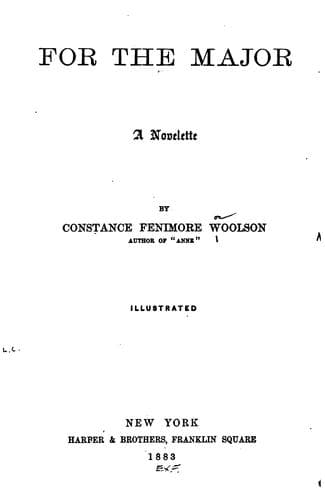
For the Major: A NoveletteWoolson, Constance Fenimore
General
For the Major: A Novelette
Woolson, Constance Fenimore
Psychological fiction; United States -- Social life and customs -- 19th century -- Fiction
His uneasiness, after spoiling his night's sleep, took him to the Farms
the next afternoon. Madam Carroll received him in the drawing-room. She
offered an excuse for Miss Carroll; it seemed that she had a headache.
But on his way out the clergyman distinctly saw the shadow of a man
thrown across the dining-room floor by the bright sunshine shining
through the western windows. It might not be the shadow of Dupont, of
course; he was ashamed of himself for his quick suspicion. It might be
that of some other visitor, or of one of their poor pensioners, or of
Caleb Inches. But no masculine visitor came to the Farms at this hour
save, now and then, the junior warden, whose small figure never cast
shadow like that; and all the pensioners of whom he had knowledge were
women. He decided that, of course, it was Inches; and then, on his way
down Carroll Lane, he met Inches coming up. Still, it was but a
supposition. He forced himself to cast it aside.
Chance, however, seemed determined to disturb him, for she soon threw in
his way other knowledge, and this not a shadow, but reality. He caught a
glimpse of Sara Carroll turning into a little-used path, which led up
the mountain to a fir-wood. His own road (he was on horseback, as usual,
on his way to a mission station) led him by Walley's Cove, and here,
fifteen minutes later, he distinctly saw the figure of Louis Dupont
entering the same wood at its upper edge, and by the path which would
bring him directly to her, the same path she herself was following.
Owen's trouble now took complete possession of him; up to this time he
had fought it off. He felt that he ought to do something, to act. Dupont
was a dissipated, erratic adventurer, whose history no one knew. Should
he let this proud, fastidious, delicate-minded girl fall into such a
vulgar trap as this? Before his eyes, within reach of his hand? Yet
there it was again--if she were in reality as proud and fastidious as he
had supposed her to be (and he had thought her the proudest girl he had
ever known), how could she, of her own accord, endure Louis Dupont? At
one time she had not endured him. There had been a memorable moment when
the expression of her eyes (how well he remembered it!) had been
unmistakable; the moment when he had met her, coming from the
drawing-room, with that alluring voice floating forth behind her. What
could have changed her--changed her so completely as this?
Public-domain text, read in full here on John Shaqi.
Reviews
Reviews
No reviews yet
Be the first to share your thoughts on this work.
Join the Discussion
Join the discussion
Sign in to leave a comment or review.
Sign InorCreate an account