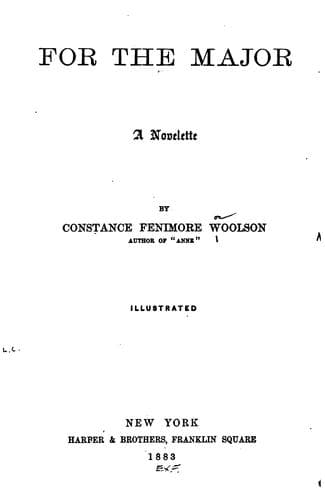
For the Major: A NoveletteWoolson, Constance Fenimore
General
For the Major: A Novelette
Woolson, Constance Fenimore
Psychological fiction; United States -- Social life and customs -- 19th century -- Fiction
The one answer presented itself with pitiless promptness: Dupont had
changed her. He had accomplished it himself, with the aid of a handsome
face, fine eyes, and an audacity which stopped at nothing; for the
clergyman had always felt sure that the audacity was there, although it
had not, in Far Edgerley, at least, been much exerted. This was so
acutely disagreeable to the man who was thinking of it, that there was
in his own eyes (handsome ones, too, in their way--a blue way) angry
moisture as he went over its possibilities. He clinched his hand and
rode on; it would have fared hardly with the musician had he crossed his
path just then. Owen was a clergyman. But he had been a man, and a free
one, first; he had not gone from college and seminary directly into the
ministry. He was thirty-one years old, and he had taken orders but two
years before; the preceding interval had not been spent in country
villages.
With all this surging feeling, however, he had as yet nothing definite
against this stranger--this stranger whose bad manners had been
protected by his "genius," and whose bad aspects had not been perceived
by the innocent little town. By nothing definite he meant nothing that
he could use. But now Chance, having given him three heavy burdens of
knowledge to carry (he had carried them as well as he could, with a
heavy heart as well)--the knowledge of those three meetings which, if
not clandestine, were at least concealed--this same Chance relented so
far as to present him with other knowledge--knowledge of a different
hue. She put in his possession some recent facts concerning the
musician which were proof, and proof positive, against him.
But what could Owen do with his facts? If he had not known what he knew
of Sara Carroll's interest in him, he could have proceeded against the
fellow at once; it needed but the statement which he was now able to
make to close every door in Far Edgerley against him, for the little
town, though not strait-laced, had a standard of morals as pure as its
own air. But if he should do this, might not Dupont take his revenge,
or, less than that, amuse himself, as he would call it, by letting the
village public learn of his intimate relations with the Farms, or rather
with Miss Carroll? Madam Carroll's liking for him, or, rather, for his
songs, was known and comprehended. But Miss Carroll's liking was not
known; and it had, too, an aspect--and here Frederick Owen felt that he
would rather go on forever in silence than have that aspect discussed.
Yet something he must do. He decided to go to Major Carroll himself.
Infirm as was his health, and secluded as was his life, he was the
natural protector of these two ladies, and would wish to know, ought to
know, everything that concerned them. He went to the Farms.
Public-domain text, read in full here on John Shaqi.
Reviews
Reviews
No reviews yet
Be the first to share your thoughts on this work.
Join the Discussion
Join the discussion
Sign in to leave a comment or review.
Sign InorCreate an account