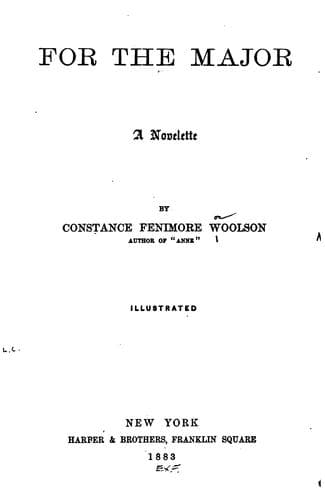
For the Major: A NoveletteWoolson, Constance Fenimore
General
For the Major: A Novelette
Woolson, Constance Fenimore
Psychological fiction; United States -- Social life and customs -- 19th century -- Fiction
On the afternoon of the day when the doctor had made up his mind,
Frederick Owen went to the Farms. Madam Carroll came down to see him;
she took him to the library, now unused, and when they had entered, she
closed the door. "Will you sit here beside me?" she said, indicating a
sofa opposite the window. Again he was struck by the great--as it seemed
to him, the marvellous--change in her. She looked even older than
before; her hair was put back in the same plain way; there was the same
absence of color, the same tired look in her eyes, the same fine
net-work of wrinkles over all her small face; but added to these there
was now a settled sadness of expression which he felt would never pass
away. He missed, too, all the changing inflections and gestures, the
pretty little manner and attitudes, and even the pronunciation, which he
had supposed to belong inseparably to her, which he had thought entirely
her own. He missed likewise, though unconsciously, the prettiness of the
bright little gowns she had always worn; she was dressed now in black,
without color or ornament.
She seemed to divine his thoughts. "The Major can no longer see me," she
said, quietly; "that is, with any distinctness. It is no longer anything
to him--what I wear."
He had taken the seat she had offered; she sat beside him, with her
hands folded, her eyes on the opposite wall. "I have a story to tell
you," she said. "But I can make no prefaces; I cannot speak of feelings.
I hope for your interest, Mr. Owen, even for your sympathy; but if I get
them it will be accomplished by a narrative of facts alone, and not by
any pathos in the words themselves. I got beyond pathos long ago. My
name was Marion More. My father was a missionary in the Southwest--the
exact localities I need not give. At sixteen I married. My father died
within the year; my mother had died long before. My first child was a
son, born when I was seventeen; I called him Julian. Later there came to
me a daughter, my little Cecilia. When she was still a baby, and Julian
was seven, my husband, in a brawl at a town some miles from our house,
killed a man who was well known and liked in the neighborhood; they had
both fired, and the other man was the better shot, but upon this
occasion his ball happened to miss, and my husband's did not. I was
sitting at home, sewing; the baby was in the cradle at my feet, and
Julian was playing with his little top on the floor. My husband rode
rapidly into the yard on his fast black horse, Tom, sprang down, came
into the house, and went into the inner room. He soon came back and went
out. He called Julian. The child ran into the yard; then hurried back to
get the little overcoat I had made for him. 'Where are you going?' I
said. 'To ride with papa,' he answered, and, eager as he was to go, he
did not forget to come and kiss me good-by. Then he ran out, and I heard
them start; I heard Tom's hoofs on the hard road farther and farther
away; then all was still.
Public-domain text, read in full here on John Shaqi.
Reviews
Reviews
No reviews yet
Be the first to share your thoughts on this work.
Elsewhere in the archive
Join the Discussion
Join the discussion
Sign in to leave a comment or review.
Sign InorCreate an account