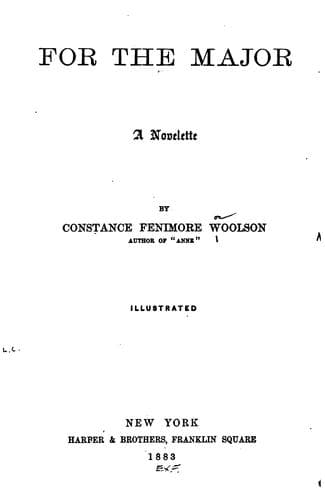
For the Major: A NoveletteWoolson, Constance Fenimore
General
For the Major: A Novelette
Woolson, Constance Fenimore
Psychological fiction; United States -- Social life and customs -- 19th century -- Fiction
But less than half an hour afterwards there
was noise enough; the garden was full of armed men. The whole
country-side were out after him. They hunted him for three days. But he
knew the woods and swamps better than they did, and they could not find
him. They knew that he would in time make for the river, and they kept a
watch along shore. He reached it on the fourth day, at a lonely point;
he turned Tom loose, took a skiff which he knew was there, and started
out with my little boy upon the swollen tide--for the river was high.
They were soon discovered by the watch on shore. Shots were fired at
them. But the skiff was out in the centre of the stream, which was very
wide just there, and the shots missed. They followed the skiff along
shore. They knew what he did not--that the river narrowed below the
bend, and that there were rapids there. He reached the bend, and saw
that he was lost; the current carried the boat down towards the narrows;
and they began to shoot again; one shot struck Julian. Then his father
took him in his arms and jumped overboard with him. That, they knew, was
death. They saw the dark bodies whirled round and round, and amused
themselves by shooting at them once or twice; they saw them sucked
under. Then, farther away, they saw them again swept along like logs,
inert, dead; on and on; two black dots; out of sight. Then they rode
back, that hunting party; and their wives came and told me, as
mercifully as they could, that my husband and my little boy were
drowned. I could not bury my dead; on the rapid current of the river
they were already miles away; in that country no one cared for the dead.
They cared but little for the living. I took my baby and went away; I
left that horrible land. I came eastward. I had no money, or very
little; my husband had taken what--what he needed for his flight, and
there was nothing left. I tried to teach little day schools for
children. I gave music lessons. I did my best. But I was not strong; my
little girl, too, was very delicate: there was something the matter with
her spine. When this life of ours--hers and mine--had lasted ten years
(for I am much older than you have supposed), I met Major Carroll. He
was so good as to love me; he was so good as to marry me; he took as his
own my poor little girl, and gave her all the comforts and luxuries she
needed--things I could not give. She died soon afterwards, in spite of
all. But in our new home she had had happy days, and when the end came
she did not suffer: she went back to God in sleep. On the 6th of last
July I was in the garden here, gathering some roses; it was below the
slope of the knoll, out of sight from the house. The gate opened, and a
young man came in. He came across to me. He introduced himself as a
stranger in Far Edgerley, who had admired our flowers. He spoke several
sentences while I stood looking at him. I was frightened; I knew not
why. At last, recovering myself, I turned to walk towards the house.
Public-domain text, read in full here on John Shaqi.
Reviews
Reviews
No reviews yet
Be the first to share your thoughts on this work.
Elsewhere in the archive
Join the Discussion
Join the discussion
Sign in to leave a comment or review.
Sign InorCreate an account