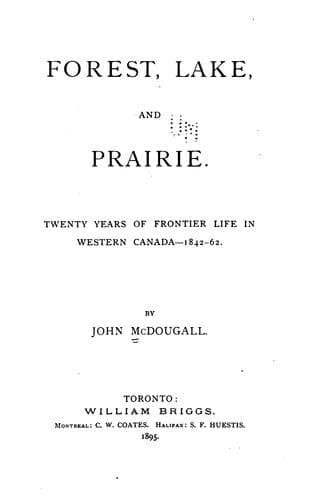
Forest, Lake and Prairie: Twenty Years of Frontier Life in Western Canada—1842-62McDougall, John
History
Forest, Lake and Prairie: Twenty Years of Frontier Life in Western Canada—1842-62
McDougall, John
Frontier and pioneer life -- Northwest, Canadian; McDougall, John, 1842-1917; Northwest, Canadian -- Description and travel
Our stay at Alderville was not a long one. Within a year my father
was commissioned by the Church to open a mission somewhere in the
north country, among the needy tribes who frequented the shores of
lakes Huron and Superior.
After prospecting, he determined to locate near the confluence of the
"Soo" and Garden rivers.
Behold us, then, moving out by wagon, on to Cobourg, and taking
steamboat from there to Toronto; thence staging across to Holland
Landing. Then going aboard the steamer Beaver, we landed one evening
at Orillia, took stage at once, and pounded across many corduroy
bridges to Coldwater, where, in the early morning, we went aboard the
little side-wheeler Gore, and then out to Owen Sound, where my
brother David joined us, and we sailed across Georgian Bay, up
through the islands into the majestic river which connects these
great lakes, and landed at the Indian village of Garden River.
I am now in my ninth year, and, as father says, quite a help.
We rented a small one-roomed house from an Indian, and into this we
moved from the steamboat. Whiskey was king here. Nearly all the
Indians were drunk the first night of our arrival. Such noise and
din! We children were frightened, and very glad when morning dawned.
Things became more quiet, and now we went to work to build a mission
house, a church, and a school-house.
Father was everywhere--in the bush chopping logs, among the Indians
preaching the Gospel, and fighting the whiskey traffic. I drove the
oxen and hauled the timber to its place. I interpreted for father in
the home and by the wayside. My brother and myself fished, picked
berries, did anything to supplement our scanty fare, for father's
salary was only $320, and prices were very high. In our wanderings
after berries I had to be responsible for my brother. The Indian
boys would go with us. Every little while I would shout, "David,
come on!" They would take it up, "Dape-tic-o-mon!" This was how the
sounds came to their ears. This they would shout; and this they
named my brother, and the name still sticks to him in that country.
My Indian name was "Pa-ke-noh-ka" ("the Winner"). I earned this by
leaving all boys of my age in foot-races. After some months of hard
work we got the home up, and moved into it. Then the school-house
was erected.
A wonderful change was going on in the meantime. The people became
sober. To see any drunk became the exception. A strong temperance
feeling took hold of the Indians. Many of them were converted.
Though but a boy, I could not help but see and note all the changes.
What meetings I attended with father in the houses, and camps, and
sugar-bushes of the people!
Our means of transport were, in summer, by boat and canoe, and in
winter, by sleigh and snow-shoes.
Public-domain text, read in full here on John Shaqi.
Reviews
Reviews
No reviews yet
Be the first to share your thoughts on this work.
Join the Discussion
Join the discussion
Sign in to leave a comment or review.
Sign InorCreate an account