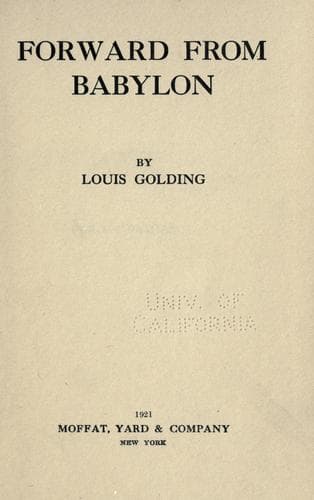
England, Northern -- Fiction; Fathers and sons -- Fiction; Jews -- Fiction
Doomington School lay outside him, poetry lay within.
Doomington School did not want him. He would wait. Perhaps he too
would some day attain the heavy-browed responsibilities of a form
monitor, might be even the monitor elected by the form itself and not
the monitor arbitrarily appointed by the master. But now all these
concerns were beyond him, unintelligible.
On the other hand, the rearrangement in his daily times produced by the
school day was a matter of considerable importance. It meant that he
arrived home nearly two hours before the nightly session of _chayder_;
with the consequence that Reb Monash was still wrapped in his afternoon
doze. Mrs. Massel had by this time cleared away every vestige of the
mid-day meal and the kitchen was smelling delightfully fresh and clean.
The brasses on the mantelshelf shone broad and lustrous--trays and
samovar brought over from Russia, and the array of candlesticks which
glorified the table every Sabbath eve. The floor had been
energetically scrubbed and the windows so polished as to seduce into
the kitchen whatever light lingered beyond the iron bars. On the sofa
sat Mrs. Massel herself, in a clean afternoon apron, her fingers busy
with knitting, allowing herself in Philip's honour the few minutes she
spent idly in a day which began at six in the morning and ended at
eleven. Mrs. Massel was a woman of middle age, slim, but her whole
body eloquent of hard work. When Reb Monash had gone to seek his
rhetorical fortunes in America, before Philip was born, she had tried
to combine the housework with some form of itinerant business; the
strain was still visible in the long lines across her forehead. Her
face was small and wrinkled and superficially older than her actual
years. When, however, she smiled, the clouds of her sorrow and
tiredness seemed to chase each other out of the skies of her face. She
was then wistful and childish as one to whom the world still had all
her tragedies to reveal. Her nose was a little too broad for the small
lines of her face, and this only added to her smile an element of the
elfin and unreal, as if she had been instructed in some wisdom of dim
mirth by little people far beyond the circle of her recurrent
drudgeries. This childlike sweetness lay in her eyes even in repose;
for they seemed large and luminous with some inner steady light, they
were brown like hill tarns when autumn is on the bracken slopes round
them. On her smiling this light seemed to be broken into little
ripples which coursed over the brown waters of her eyes; but a surprise
and a doubt at no time deserted them, as if beyond the horizon clouds
lay ever waiting to veil these brown lights with mist.
Public-domain text, read in full here on John Shaqi.
Reviews
Reviews
No reviews yet
Be the first to share your thoughts on this work.
Join the Discussion
Join the discussion
Sign in to leave a comment or review.
Sign InorCreate an account